
Apple's services grew 12% while its US App Store commissions fell 18%
Apple's filings now warn that developers using alternative payment and distribution may cut its commission to zero. US commission revenue is down 18% year to date and US App Store consumer spending down 6%, yet total services revenue grew 12% to $30.7 billion and the growth rate accelerated.

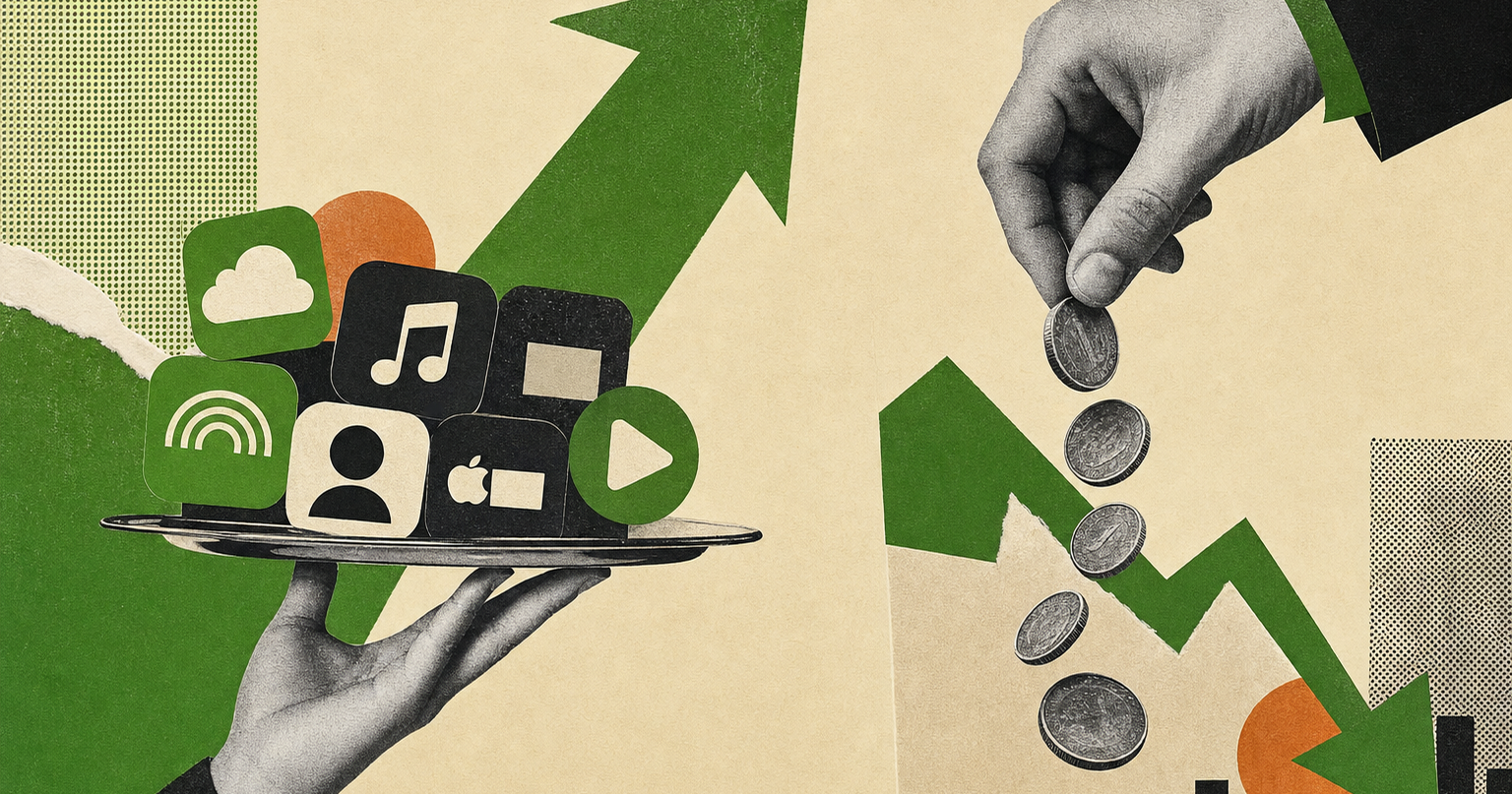
Apple has told investors that antitrust remedies are eating into its App Store commissions. The numbers say the bite is real, localised, and so far smaller than the growth around it. Both halves of that sentence matter, and most coverage has only carried one.
Which $100 billion
The "$100 billion services business" is a round-number shorthand, and it now understates the segment. Services revenue reached $30.7 billion in the most recently reported quarter, up 12% year over year, as PYMNTS reported. At that quarterly rate, services annualises to roughly $123 billion. Apple's services line passed $100 billion some time ago; the label stuck.
Scale matters here because it sets the denominator. A commission problem inside the App Store is a problem inside one component of a $123 billion segment, not a problem with the segment.
What actually bites
The mechanism is anti-steering. Following the US ruling in the Epic Games litigation, developers can direct customers to payment methods outside the App Store, and increasingly to direct-to-consumer distribution. When a sale completes outside Apple's payment rail, Apple's take is reduced or eliminated.
Apple states the risk in its own filing language:
"If third-party developers use alternative methods of distribution and payment for their apps and digital content, including direct-to-consumer distribution models, the company may earn a lower commission on such sales, or may not earn a commission at all."
Note what that sentence does and does not say. It is a commission-rate risk, not a revenue-recognition risk on the whole segment, and the operative phrase is "may earn a lower commission ... or may not earn a commission at all." Apple is describing leakage from a toll booth, not the closure of a road.
The pressure is not confined to one jurisdiction. Alongside the US Epic decision, Apple faces the UK Competition and Markets Authority, the European Union, Japan and Brazil. The EU regime is the structurally harshest, because the Digital Markets Act reaches distribution itself, alternative app stores and sideloading, rather than only the steering of payments. The US remedy changes where a customer pays. The EU remedy changes who gets to run a store.
The two numbers that disagree
Here is the tension the headline version misses.
Against Apple: US App Store consumer spending fell 6%, and Apple's US commission revenue fell 18% year to date. That is a genuine, measurable transfer of value from Apple to developers, and an 18% decline is not a rounding error.
For Apple: total services revenue still grew 12%, and it accelerated, against 9% growth in the same quarter a year earlier.
Both are true at once, and the arithmetic forces a conclusion: US App Store commission must be a minority of the services segment, and the rest of services, advertising, iCloud, Music, TV+, payments and the search default arrangement, is growing fast enough to absorb an 18% decline in one component and still post an accelerating segment number.
Anyone writing that antitrust is "hurting" Apple's services business is describing the commission line correctly and the segment incorrectly. Anyone writing that antitrust has had no effect is ignoring an 18% decline in a real revenue stream. The accurate version is that the erosion has started, it is currently confined to US commissions, and it is being outrun.
The takeaway
For a model, the usable figure is the spread: US commission revenue at negative 18% year to date against total services at positive 12%, which is a 30-point gap between the component under legal attack and the segment containing it. Track whether that gap widens. It widens if EU sideloading and alternative app stores move real volume off the App Store, because that hits distribution rather than steering, and it narrows if commission erosion stays a US anti-steering story.
The date to watch is Apple's next quarterly filing. Two things to check when it lands: whether services growth holds double digits once the anti-steering remedies have been in force for a full comparable year, and whether Apple begins disclosing a separate figure for commission revenue. A company that starts breaking out a number usually does so because the number has become material enough to explain.
Some offers on this page may be paid placements or contain affiliate links.
Finpresso: daily AI & finance brief
Free daily newsletter, read in 5 minutes.
Subscribe free