
The Fed's Bank Cop Says Its Own Committees Gave Examiners 'Plausible Deniability,' So She's Redrawing the Map
Michelle Bowman says the Fed's maze of supervisory committees slowed action and blurred accountability before Silicon Valley Bank collapsed. Her fix: five regions, clear bosses, and looser thresholds for a lot of banks.
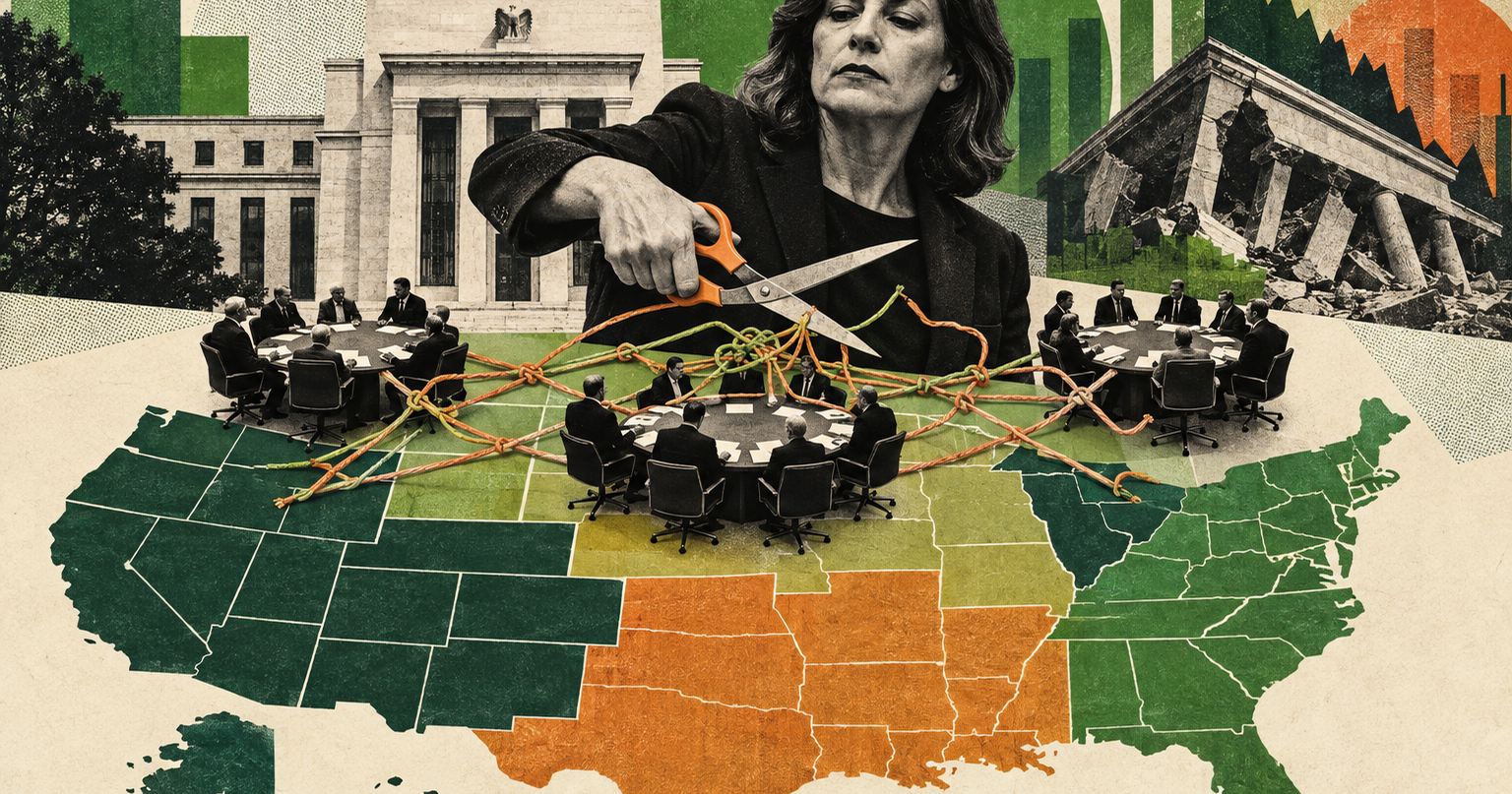
The Federal Reserve's top bank regulator just told a room of bankers that the Fed's own supervisory machinery made it easier for examiners to dodge hard calls. Now she's tearing it up.
Michelle Bowman, the Fed's Vice Chair for Supervision and a former Kansas state bank commissioner, announced the restructuring on Tuesday, 6 October, at the Community Banking Research Conference in St. Louis. Supervision is officially her job, but it is carried out by the 12 regional Reserve Banks through what she called "a complex web of dozens of committees."
Those committees, she said, "became a source of delay, created barriers to prompt action, and obfuscated decisionmaking responsibility and accountability." Then the sharper line: "In practice, these committees became a source for plausible deniability and a disincentive for examiners to take prompt and decisive action to address identified risks."
The SVB autopsy
The trigger is an independent review of Silicon Valley Bank's failure by the Starling Advisory Group. Bowman received its preliminary report last month and presented initial findings in London on 18 September. "The independent review highlighted a long-standing structural issue in the supervisory function, a mismatch between authority for decisionmaking and accountability for supervisory decisions," she said.
That matters because SVB, Signature Bank and First Republic, which all failed in 2023, are the second, third and fourth largest bank failures in US history. SVB's collapse is still in court, too, with a judge recently blocking SVB's parent trust from a $1.71 billion FDIC claim after ruling the bank's leaders breached their duties.
Five regions, one boss each
The fix is a new map. Supervision will be realigned into five regions that follow state lines rather than Reserve Bank district boundaries, modeled on the Conference of State Bank Supervisors' regional structure. Each region gets a leader accountable for all supervisory activity there.
Examiners aren't going anywhere. They stay in their existing Reserve Bank offices and keep supervising the same banks. What changes is who answers for the decision when something goes wrong.
And looser lines for many banks
The other half of the speech points the opposite way. The Fed will widen what counts as a "community bank," a label defined for 15 years as under $10 billion in assets, so traditional lenders aren't pushed into tougher tiers. Later this year it will propose raising the fixed-dollar asset thresholds in its rules for inflation and growth, with automatic updates every five years. That builds on the plans to lift the thresholds that trigger the Fed's toughest rules reported in September.
TD Cowen analyst Jaret Seiberg wrote that the new thresholds could be 50% higher. "That means the $100 billion threshold would be $150 billion, the $250 billion would be $375 billion."
Bowman also wants to update CAMELS ratings so the "M," for management, no longer singularly drives a bank's composite score, and to revise Regulation O on loans to bank insiders, which hasn't been comprehensively updated since 1979. "The Federal Reserve's supervisory approach should not be a mystery," she said.
More than three years after the 2023 failures, the Fed's answer is clearer lines of command paired with lighter rules for a lot of banks. The next time a bank wobbles, it will show which half of that bargain mattered more.
Finpresso: daily AI & finance brief
Free daily newsletter, read in 5 minutes.
Subscribe free