
China Shut Down a Record 670 Banks in One Year, Nearly One in Four Lenders, as Its Rural Banks Buckle
China closed more than 670 banks in 2025, a record that wiped out roughly one in four lenders. Almost every bank that disappeared was a small rural lender.

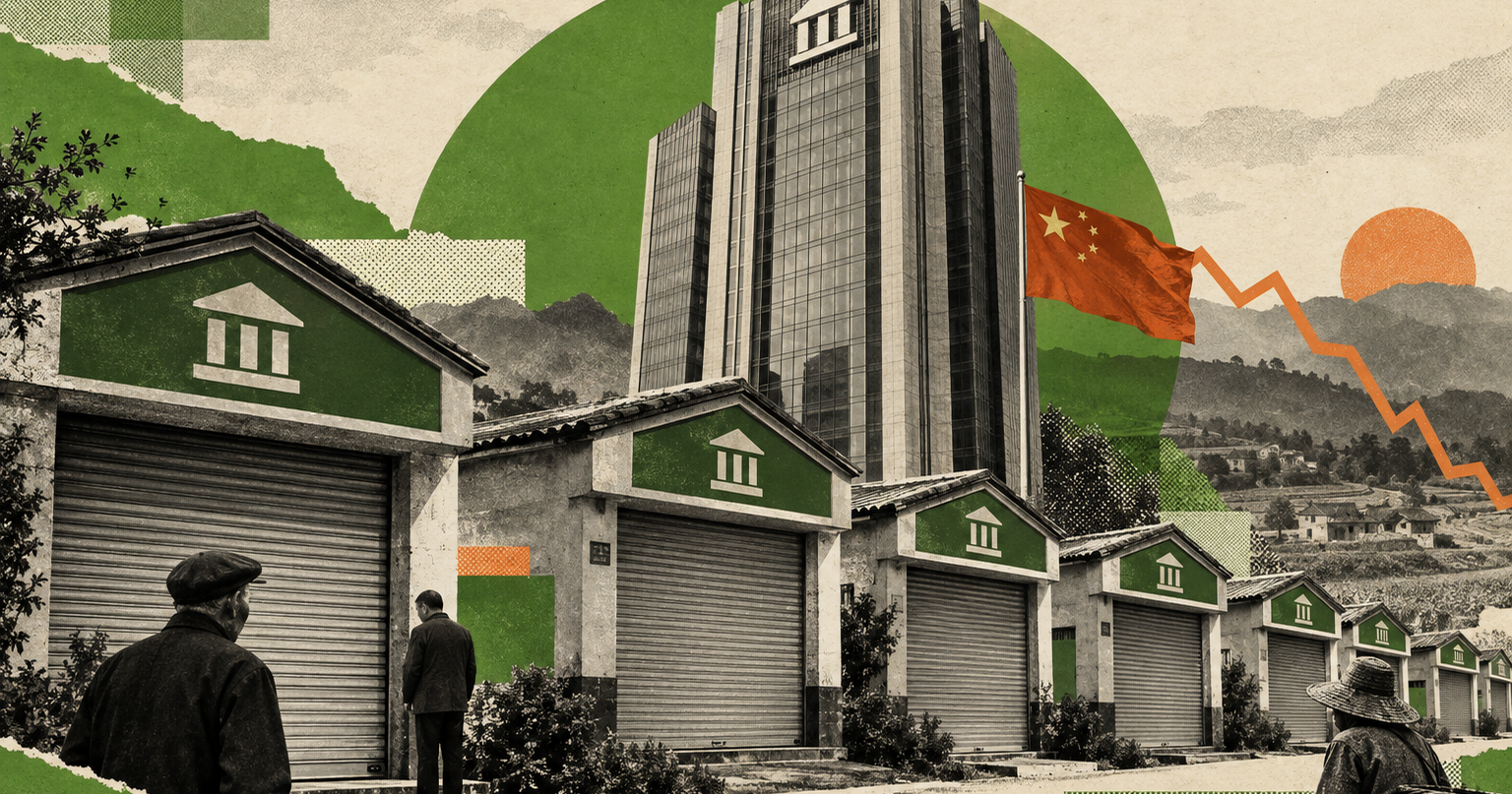
China closed more than 670 banks in 2025, a record, wiping out roughly one in four of its lenders in a single year. Beijing is pushing mergers and dissolutions to end up with fewer, larger and better-capitalized banks, and almost every institution that disappeared was a small rural lender.
The figures come from China's National Financial Regulatory Administration and a Fitch Ratings analysis. After the closures, China has 3,139 banking entities left, a 23% drop in the four years to 2025.
"We've never seen consolidations on this scale before," said Jason Bedford, a senior visiting research fellow at the East Asian Institute at the National University of Singapore. He described the push as "regulatory simplification" aimed at "eliminating the potential for liquidity events among small institutions."
The weakest part of the system
Fitch does not mince words about the banks being folded away. Small and rural commercial banks "remain the weakest part of the system, with poor asset quality, low capitalization and governance shortcomings," it said, especially in less developed regions.
The numbers back that up. Rural banks' return on assets fell to 0.45% in the first half of 2026, down from 0.56% in 2021. Their nonperforming loan ratio climbed to 2.8%, against a 1.5% average for the whole sector.
That bad-loan gap reflects who these banks lend to: smaller companies, property developers and local government financing vehicles, the off-balance-sheet borrowers that funded years of infrastructure spending. Rural and city-level banks together hold more than a quarter of China's banking assets, and city-level banks are now under closer scrutiny too.
Profits squeezed from every side
Low interest rates, deflation and a long property slowdown have all eaten into bank profits. A Rhodium Group analyst put the bind plainly: after a massive credit expansion drove growth, "the financial system's problems now constrain that growth."
The wider economy is not helping. GDP grew 4.3% in the second quarter of 2026, the slowest pace since 2022, and industrial profits rose just 4.2% year on year in August, the weakest pace this year. Trade pressure has eased somewhat with the US-China truce extension, but that does little for a rural lender sitting on souring property loans.
Fitch says the campaign is meant to boost oversight, curb regulatory arbitrage and improve transparency. It also thinks stress at small lenders is unlikely to spread systemwide, because they are localized and have limited exposure to other banks.
The shake-up could "ultimately reshape competitive dynamics among smaller lenders, although their structural weaknesses may persist in the near term," Fitch said. It is a very different instinct from Washington, where the Fed is drafting a plan to raise the asset thresholds that trigger its toughest bank rules. Beijing's answer to its weakest banks is to make them disappear.
Some offers on this page may be paid placements or contain affiliate links.
Finpresso: daily AI & finance brief
Free daily newsletter, read in 5 minutes.
Subscribe free