
China's AI Export Boom Pulled Growth Up to 4.5% as Property Investment Sank 20% and Consumers Held Back
China's economy grew 4.5% in the third quarter, up from 4.3%, as global demand for AI chips, electronics and batteries lifted exports, while property investment fell 20.6%, total investment dropped 7.2% and retail sales barely grew.

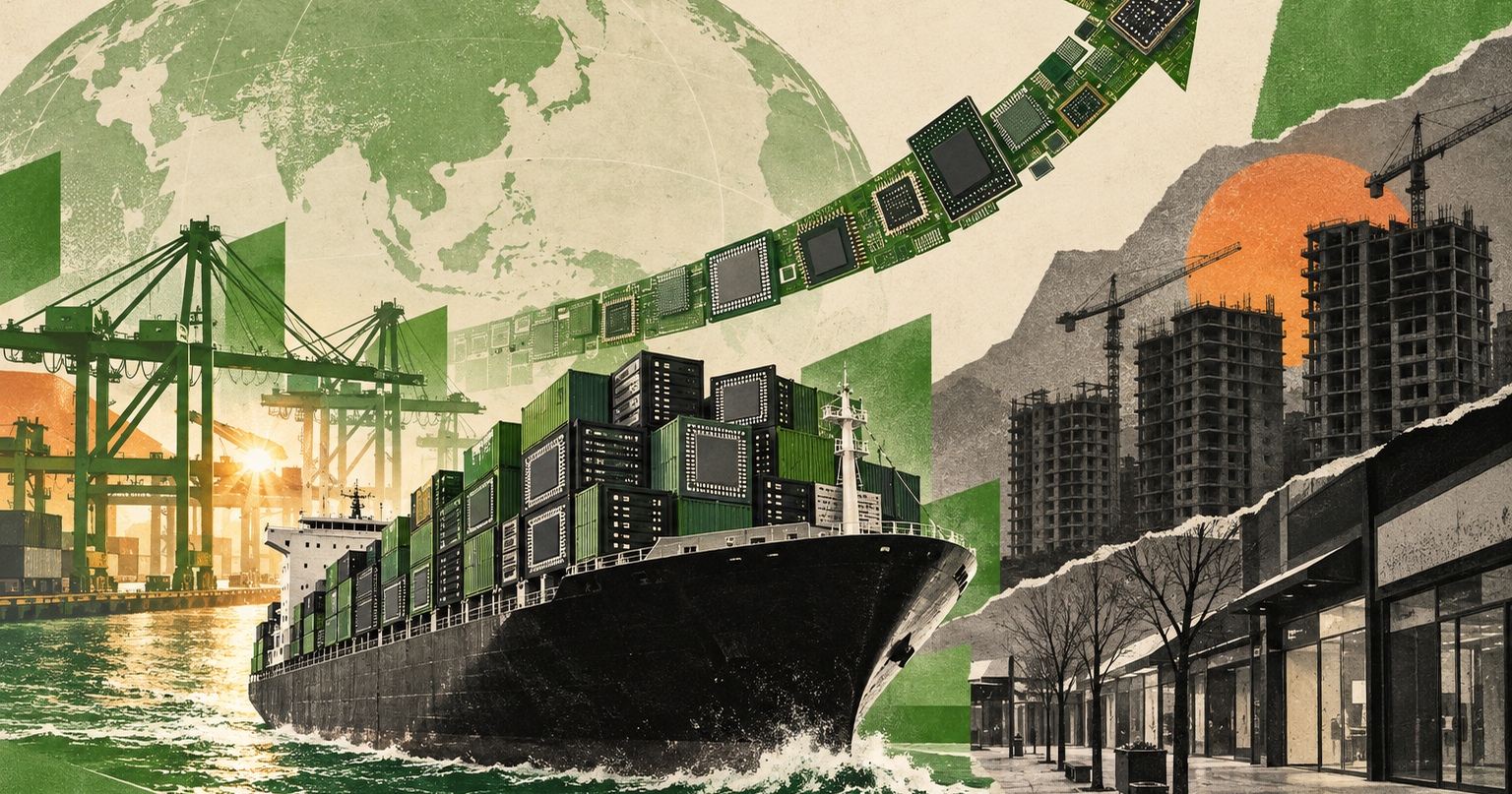
China's economy grew 4.5% in the third quarter from a year earlier, up from 4.3% in the second, which was a more than three-year low. Most of the lift came from abroad, where companies building AI data centers are snapping up Chinese chips and electronic components, alongside a boom in batteries and other green tech.
Inside the country, the picture looks very different. Economists now describe a two-speed economy: a thriving export engine on one side, weak investment and stagnant consumption on the other.
The fast lane
The factories are humming. High-tech manufacturing output rose 14.3% in the first three quarters and equipment manufacturing 10.2%, according to the National Bureau of Statistics. Production of lithium-ion batteries jumped 39.5% and industrial robots 29.1%.
The ports tell the same story. Customs data showed September exports up 36.3% in dollar terms from a year earlier, the biggest jump since early 2021, with shipments to the US up 39.6% during the trade truce. That follows the 25% surge in August on tech and AI demand. The trade surplus reached $938.1 billion in the first nine months, and the BBC reports it is on track to beat last year's record of $1.2tn.
The slow lane
Everything else is stuck. Real estate development investment fell 20.6% in the first three quarters, as the housing downturn enters its fifth year in a country where an estimated 70% of household wealth is tied up in property. Total fixed-asset investment fell 7.2%, private investment 10.4% and infrastructure 4.2%.
Shoppers are not picking up the slack. Retail sales of goods grew just 1.0% over the first three quarters, and total retail sales of consumer goods rose 1.1% both year to date and in September.
Beijing does not hide it. "The issue of insufficient domestic demand remains prominent," the statistics bureau said, pledging to step up efforts to boost spending at home. Vice-minister Mao Shengyong put a brighter spin on it: "The economy moved forward under pressure and developed in a newer and better direction."
The 4.5% figure sits right at the bottom of Beijing's growth target of 4.5 to 5%. Growth in the first three quarters was 4.6%, and the third quarter rose 1.2% from the second.
One engine is a risk
Sheana Yue of Oxford Economics sees no sign the property slump will end soon and says trade uncertainty and geopolitics have made consumers more "pessimistic" and unwilling to spend. Dave Chia of Moody's Analytics warns about China's reliance on a "single external engine." Last month's limited stimulus, including mortgage subsidies for first-time buyers and targeted rate cuts, has yet to show results.
The IMF is already more cautious. Last week it cut its 2026 forecast for China from 4.6% to 4.5% and its 2027 call from 4.1% to 4%, blaming persistent weak demand at home.
The export engine also has political limits. Western economies, including the US and EU, are pushing back as their manufacturers struggle against cheap Chinese goods, and there are doubts over whether AI infrastructure spending will pay off. Beijing and Brussels reached an initial deal this month that caps China's hybrid vehicle exports to the EU. Xi Jinping and Donald Trump extended their trade truce to January and agreed tariff cuts on $60 billion of goods, and they are due to meet again in November at the APEC summit in Shenzhen.
Some offers on this page may be paid placements or contain affiliate links.
Finpresso: daily AI & finance brief
Free daily newsletter, read in 5 minutes.
Subscribe free