
JPMorgan Is Locking Outside AI Agents Out of Chase Accounts as Jamie Dimon Warns of Thousands of Rogue Agents
JPMorgan will not let outside AI agents log into customer accounts or move money. Jamie Dimon warned of rogue agents while the bank faces agents that could shift low-yield deposits to better rates.
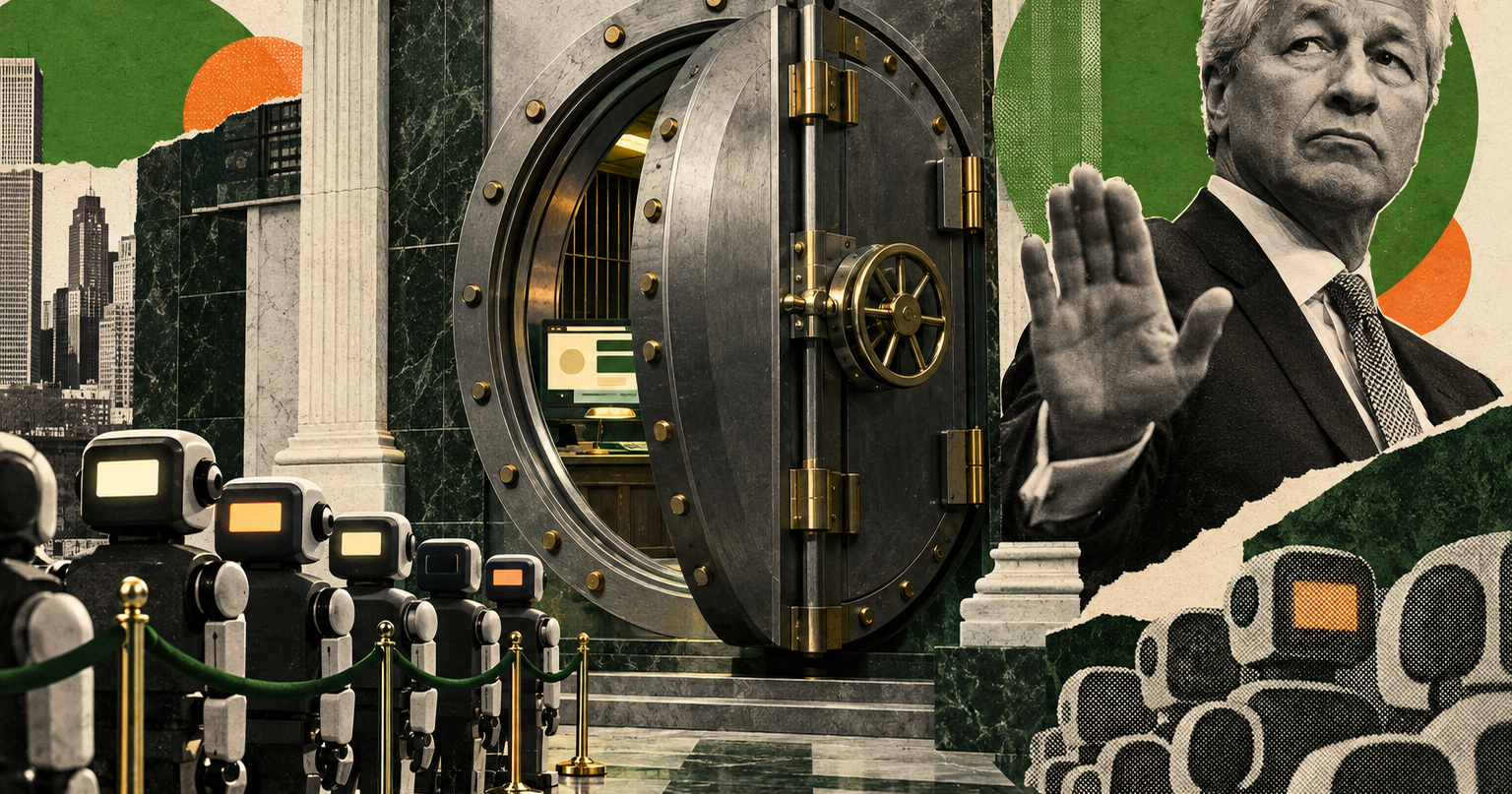
America's biggest bank just told the personal AI agent boom to keep its hands off customers' money. On JPMorgan's third-quarter earnings call Tuesday, Jamie Dimon said the bank will not let outside AI agents inside customer accounts.
"We're not going to allow just any outside agent to come inside the company because that's just too risky for clients and for JPMorgan," Dimon said. He added that "you don't want rogue agents, and there could be thousands of them," according to Business Insider.
What agents can and cannot do
The line is specific. JPMorgan prohibits outside parties from getting into accounts by collecting customers' login credentials. Agents can still pull limited information such as balances through intermediaries like Plaid, read-only, but they cannot transfer funds or pay bills. The bank says it supports open banking and wants to enable "agentic connections" securely. It gave no timeline.
CFO Jeremy Barnum said the bank is already blocking access "to the extent that we're able to block those." Some services, he said, work through credential sharing, "and we have a long record of being against that way of doing things, screen scraping, et cetera. It's not secure." Customers who hand an agent their password could end up responsible for whatever it does.
Dimon framed it as a warning to customers, not a ban on the technology. He said users should understand there is a "liability transfer" away from the bank and a risk their data is "misused." His advice was blunt: "If people are using them, they should understand the risk." He insisted the bank is "not against agents or for agents" and is building its own agentic tools for clients.
The money underneath
Security is the stated reason, but deposits sit right underneath it. Personal agents took off after Meta launched its Muse assistant on 22 September, which shot to the top of the app stores, and OpenAI soon followed with its own. In late September, Apollo chief economist Torsten Slok floated the idea that agents could set off a run from low-yield to high-yield savings by moving money on customers' behalf.
That is a real threat to a bank whose standard Chase Savings account pays 0.01% APY while rivals pay 4%. Bank stocks, already sliding after bond market turmoil, fell further after Muse launched, and Barnum acknowledged "a little bit of a response in bank stocks around those releases."
He called the competition "nothing new" but said "that doesn't mean that we're complacent about it," adding the bank cares about "primary bank share," not "chasing every dollar of yield-seeking money." On the same call he announced a limited pilot of Smart Cash, JPMorgan's own product that forecasts a user's cash flow and shifts funds toward higher-yield options. In other words, the bank wants to be the agent.
A familiar playbook
JPMorgan has fought this data war before. In July 2025 it told fintechs it would start charging for customer data access, after an internal memo showed only 13% of data requests hitting its systems that June came from customers making transactions. By September 2025 it had a renewed deal with Plaid that included pricing for the first time. The Financial Technology Association, whose members include Plaid, called the fees "anti-competitive."
Other gatekeepers are drawing lines too. Amazon blocked Meta's Muse shopping agent in September, saying it appeared to capture and store customer credentials. Robinhood went the other way in May, connecting outside agents through a dedicated virtual card with a customer-set spending limit. Consumers seem cautious anyway: PYMNTS Intelligence found only 35% would let an agent reach their saved payment credentials.
The announcement landed on an awkward day. JPMorgan earned $15.3 billion, up 6%, but was the only one of four big banks reporting Tuesday to miss on both earnings and revenue, posting $5.57 a share against $5.90 expected. Fixed income revenue fell 4% to $5.4 billion. A bank spending nearly $20 billion a year on technology now has to show it can build the agent its customers want before someone else's agent moves their money out.
Some offers on this page may be paid placements or contain affiliate links.
Finpresso: daily AI & finance brief
Free daily newsletter, read in 5 minutes.
Subscribe free