
Oil Tops $111 After Houthi Attacks Kill Three in Saudi Arabia and Washington Orders Some Diplomats Out
Brent rose to about $111.64 a barrel after Houthi attacks killed three people at a Saudi oil field and a Dammam airport and the US ordered some diplomats to leave Saudi Arabia.

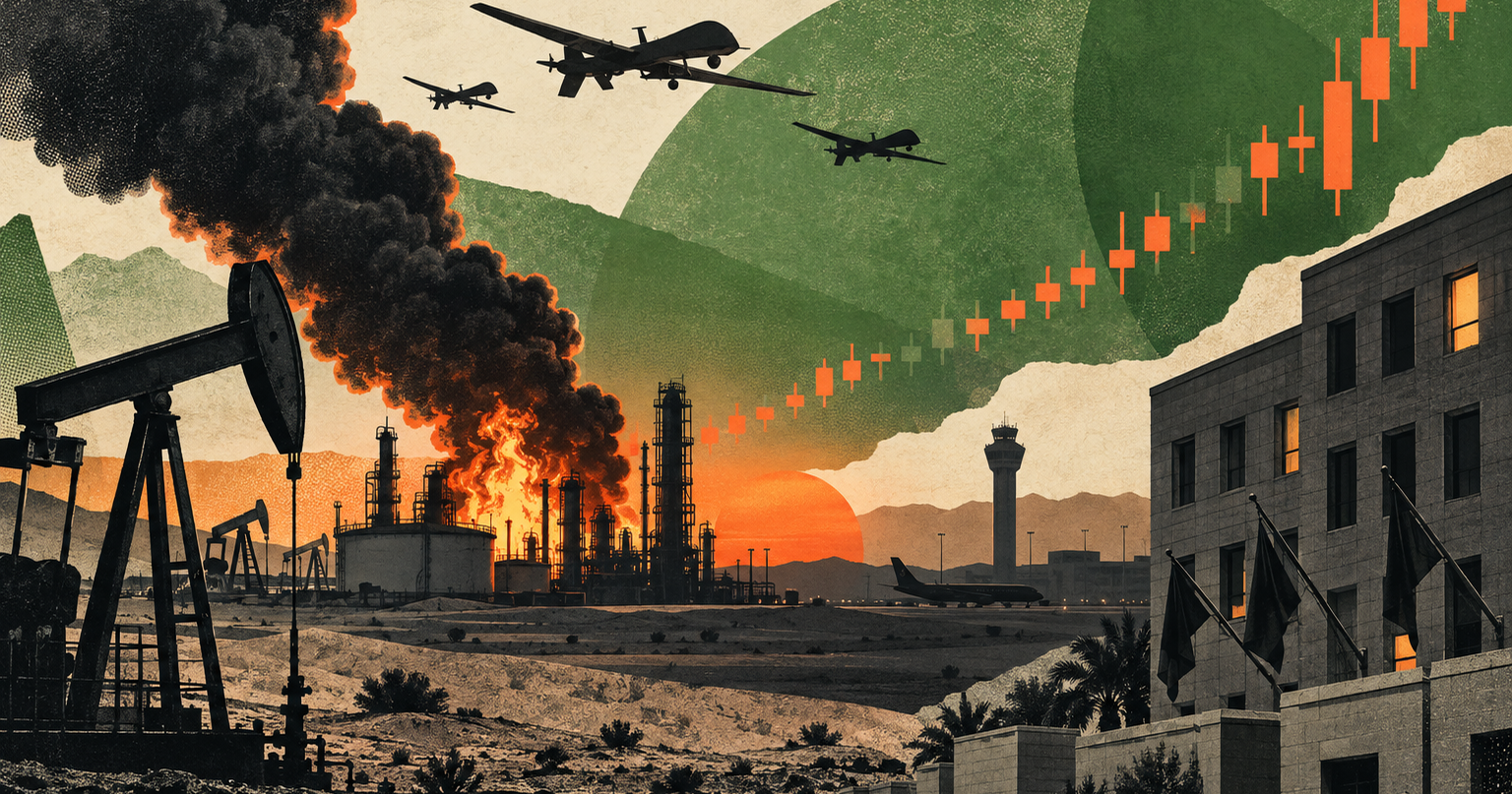
The war around the Gulf landed on Saudi soil again this week. On Wednesday, Yemen's Iran aligned Houthis struck several targets in Saudi Arabia, killing two people in a drone attack on an oil field and at least one more at a civilian airport in Dammam, where eight were wounded. Washington then ordered some diplomats and their families out of the kingdom.
Oil did what oil does. By Thursday morning Brent was up $2.82, or 2.59%, at $111.64 a barrel, close to a five month high. US crude, WTI, rose $2.24, or 2.31%, to $99.39.
"Oil prices remain well bid, with ICE Brent back above $110 per barrel this morning following additional deadly attacks on Saudi Arabia," analysts at ING wrote.
Diplomats told to leave
The US ordered some diplomats and family members to leave its missions in Saudi Arabia, with the order covering non emergency personnel. US officials told Reuters the State Department also plans to withdraw family members from a number of other US missions in the region.
Much of the market's recent fear has centered on shipping lanes. Strikes on Saudi soil, on an oil field and an airport, put the producer itself in the line of fire.
Iran says it has no trust in talks
Tehran is not sounding like a government about to make a deal. Foreign minister Abbas Araqchi told the Financial Times that Iran is fully prepared to defend itself and that "we have no trust whatsoever in the sincerity of the US administration's professed desire for peace with Iran," pointing to two occasions when the US attacked Iran while negotiations were under way. President Masoud Pezeshkian said the US cannot expect dialogue while it blockades and threatens Iran.
Explosions were also heard in Sirik in southern Iran. Iranian media said their nature and origin were unknown.
At sea, the Islamic Revolutionary Guard Corps Navy claimed that four vessels involved in what it called "illegal" oil transfers in the northern Persian Gulf were hit at the same time and caught fire, and that three more vessels struck mines west of the Strait of Hormuz. It warned the US military that continued provocations could bring a wider response against American bases in the region.
The shipping war was already pushing prices up before Wednesday's strikes, after Iranian tankers went up in flames and sent Brent to a five month high earlier this week. Kpler counts at least 18 attacks on shipping in two weeks. LSEG analysts say Iran is now targeting tankers well beyond Hormuz, into the Gulf of Oman, which puts Gulf crude loadings and ship to ship transfers at risk.
Short on diesel at home
The supply picture in the US is tightening too. Crude stocks fell 3.06 million barrels to 412.5 million last week, according to the Energy Information Administration, far more than the 820,000 barrel draw analysts expected. Distillate stocks rose 1.68 million barrels to 104.3 million, against expectations of a 1.16 million barrel drop.
That build has not eased the pressure on fuel. Diesel shortages caused by the wars in Iran and Ukraine have pushed prices up enough that the Trump administration is offering to loan up to nearly a third of the 1 million barrel Northeast emergency heating oil reserve.
The one note of diplomacy came from elsewhere. In St Petersburg, Vladimir Putin hosted US envoy Steve Witkoff, and the Kremlin said Putin agreed to resume US mediated peace talks with Ukraine as soon as next month, with Volodymyr Zelenskiy's support.
Some offers on this page may be paid placements or contain affiliate links.
Finpresso: daily AI & finance brief
Free daily newsletter, read in 5 minutes.
Subscribe free