
Trump Announced a $54 Billion Korean Alaska LNG Deal That Seoul Never Signed, Then Threatened to Double It Up
Trump announced Korean money for an expensive Arctic gas project before Seoul agreed to anything. When Korea objected, he threatened to make it pay more.

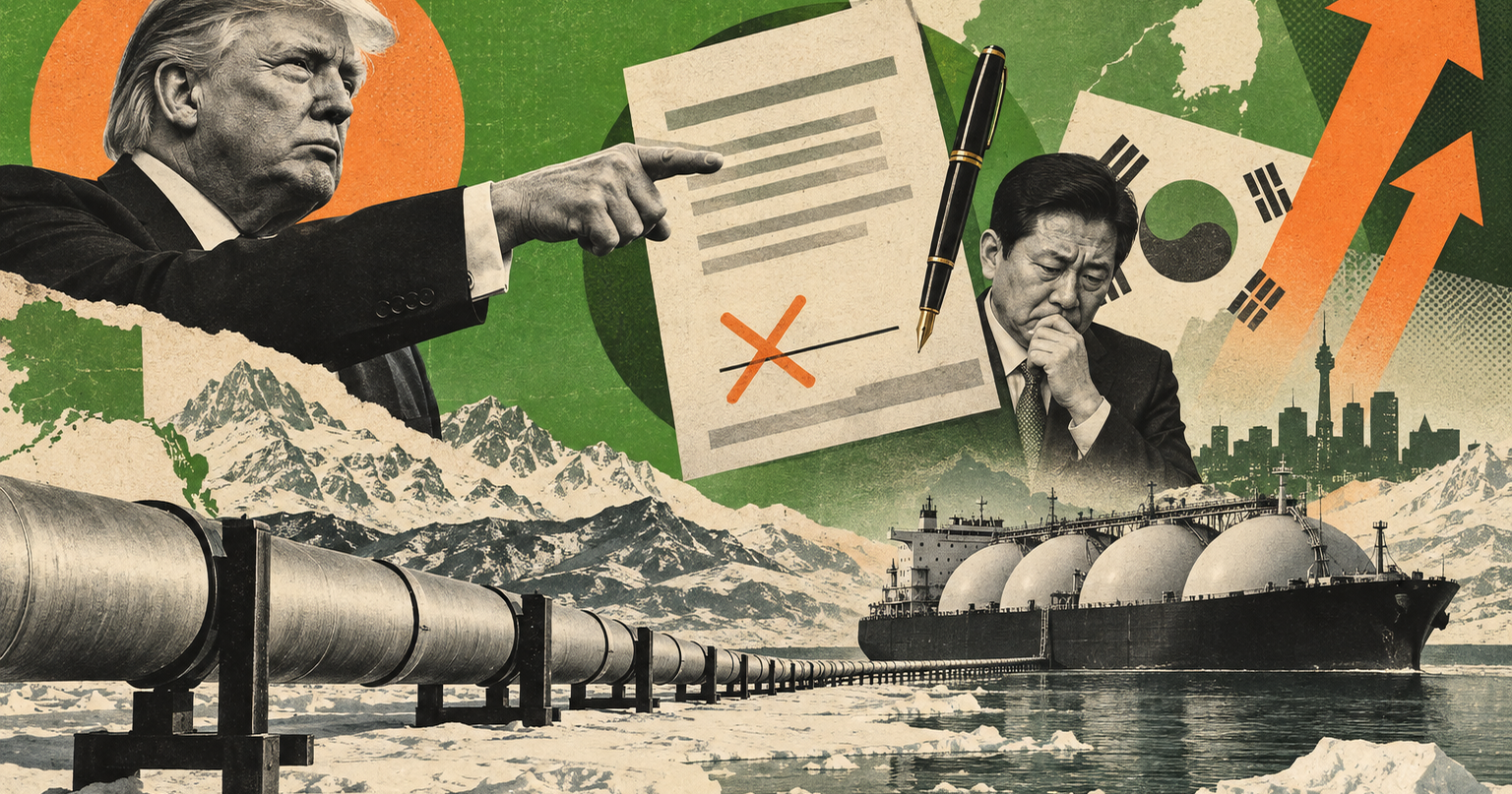
Donald Trump stood in the Oval Office last Wednesday, surrounded by Alaska's governor, senator and three cabinet secretaries, and announced a $54 billion South Korean investment that includes the Alaska LNG project. There was one problem. Seoul says it never agreed to it.
Industry Minister Kim Jung-kwan said the announcement went "far beyond what was agreed." His ministry said the two countries had only agreed, under a memorandum of understanding, to review the project's commercial viability and legal compliance, and that "nothing has been decided regarding whether to invest or the size of any investment."
"I'll just charge them more"
Kim was blunter at home. "We judge it on commercial viability and if it doesn't pass we don't proceed," he said, adding that "the U.S. appears eager to use this project for domestic purposes." He said he raised a strong objection with Commerce Secretary Howard Lutnick.
Asked on Friday whether he had jumped the gun, Trump didn't back down. "I didn't jump the gun. I mean, they were there and they were represented," he said. "If they don't want to do it, that's OK with me. I'll just charge them more." Then: "Tell them if they don't sign shortly, I'm going to double it up."
He did not specify what he would double, and Korean media pointed to tariffs. The US already charges a 15% tariff on Korean goods, and in January Trump said reciprocal tariffs could rise to 25% over delayed Korean investment, the same threat-first approach he recently aimed at Europe over Canada.
The deal keeps growing
The same day, Trump said on Truth Social that the deal "keeps getting BETTER" and announced an additional $8.4 billion enhanced oil recovery project. Seoul's industry ministry reportedly said that project was not part of any agreement either, and it asked Washington through trade channels to explain.
The backdrop is a $350 billion US investment package that Korea's legislature approved as part of last year's trade deal: $150 billion for shipbuilding and $200 billion for strategic projects. Senator Dan Sullivan's office says three projects were agreed, including Alaska LNG, and that "this is going to get built."
Why Seoul is wary
The economics explain the hesitation. Alaska LNG means an 800-mile pipeline from the North Slope to an export plant in southern Alaska, at an estimated $44.5 billion to $54.5 billion. That works out to about $2.2 billion to $2.7 billion per million tons per annum of capacity, versus roughly $1 billion or less for Gulf Coast projects approved since Russia invaded Ukraine.
Developer Glenfarne argues shipping to Asia will be at least 65% cheaper than from the Gulf Coast. It has customers lined up for 13 million tons a year, but needs 16 million to support project financing. Gas buyers have reasons to want new supply, with Europe heading into winter on historically thin storage. Seoul's position is that it will pay only if the numbers work, and Trump's is that Korea will pay one way or another.
Some offers on this page may be paid placements or contain affiliate links.
Finpresso: daily AI & finance brief
Free daily newsletter, read in 5 minutes.
Subscribe free