
The AI Buildout Just Pushed the US Trade Deficit to $105.6 Billion, Its Widest Since Before Liberation Day
The tariff wall was supposed to shrink the gap. Then America went shopping for AI chips, oil and gold, and August's trade deficit jumped back near its record.

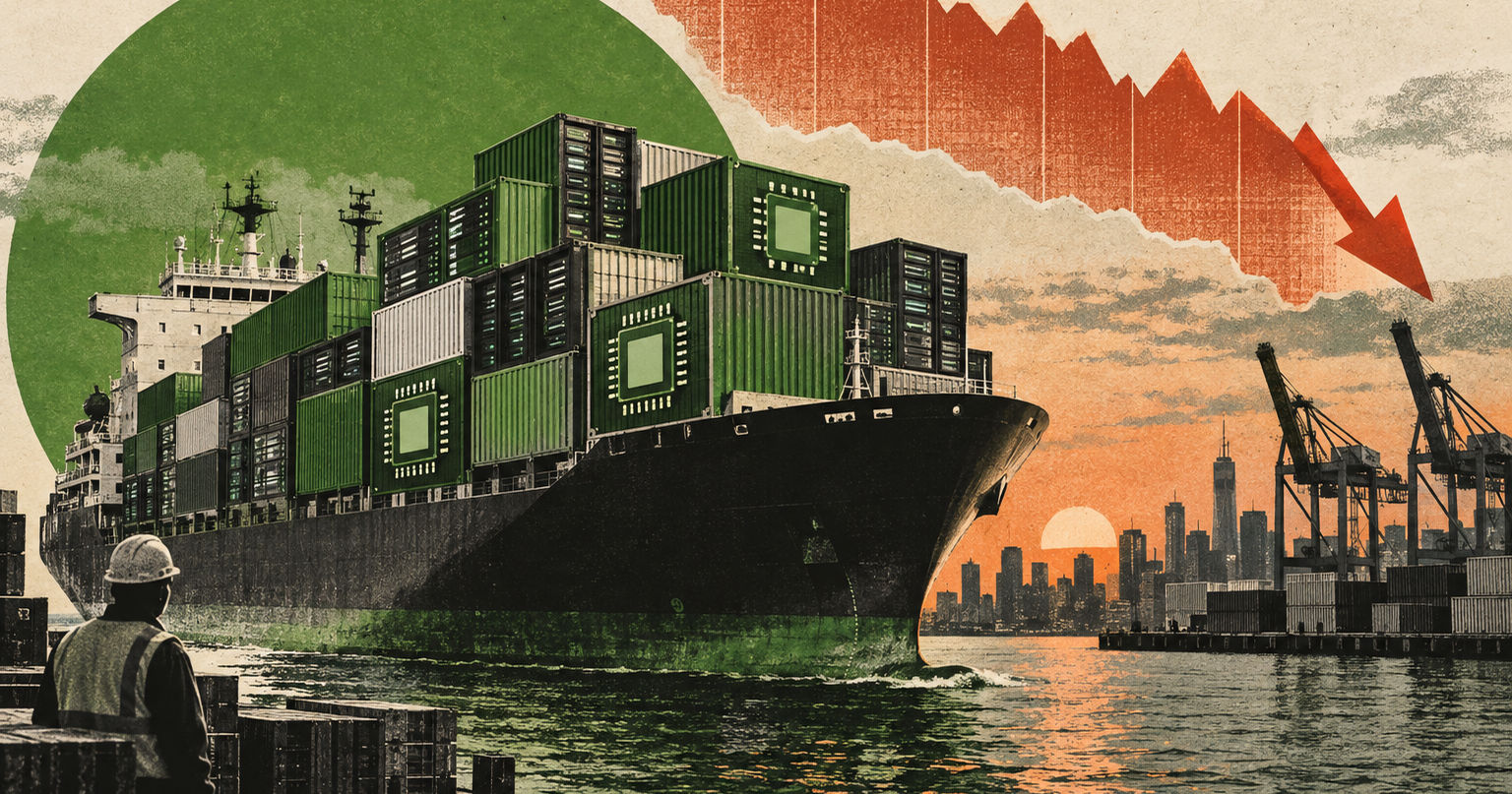
America's appetite for AI hardware, with some help from oil and gold, just blew a hole in the trade numbers. The US goods and services deficit widened to $105.6 billion in August, the Commerce Department reported Tuesday, up $12.7 billion, or 13.7%, from a revised $92.8 billion in July.
That beat the $102 billion economists expected. It is also the widest monthly gap since March 2025, the all-time record month, set right before President Trump's "liberation day" tariff announcement.
Chips, oil and gold
Imports rose 4.3% to $420.8 billion while exports climbed just 1.4% to $315.2 billion. The goods deficit alone grew $12.8 billion to $136.6 billion, partly offset by a services surplus of about $31.0 billion.
Two categories did most of the damage. Imports of industrial supplies and materials rose $9.1 billion, much of it crude oil and nonmonetary gold. Capital goods imports climbed $6.2 billion, led by semiconductors headed for the data center buildout.
The map tells the same story. Mexico ran the largest bilateral goods deficit at $27.7 billion, followed by Vietnam at $24.0 billion and Taiwan at $18.3 billion, ahead of China at $16.4 billion. Taiwan, home of the world's most advanced chip fabs, now sits third. The gap with Canada also grew $4.1 billion to $7.1 billion.
The tariff wall vs. the AI boom
The tariffs were sold as a way to close this gap. The AI boom runs on imported chips and servers, and tariffs haven't stopped companies from buying them. SpaceX, for one, has been looking to borrow $40 billion to buy Nvidia chips.
One bad month doesn't erase the year, though. Through the first eight months of 2026, the deficit is still about 20% narrower than the same stretch of 2025, having narrowed by $138.2 billion. Comparisons are messy because companies rushed imports in early 2025 to get ahead of the tariffs, which inflated last year's numbers.
Trade policy is still moving underneath all of this. After the Trump and Xi meeting, Washington and Beijing published $60 billion in tariff-cut lists, and China's $16.4 billion August gap now trails three other countries. The deficit hasn't gone away so much as moved, toward the places that build the chips and assemble the servers.
Not everyone reads August as a warning light. "Rising prices overstate the moves, but nonetheless net trade is set to drag on Q3 GDP growth," said Oren Klachkin of Nationwide. "We see this as a sign of strong domestic demand, not economic weakness."
The drag is showing up in forecasts anyway. Goldman Sachs cut its third quarter GDP tracking estimate by 0.3 point to 3.1%, and the Atlanta Fed's GDPNow model slipped to 3.7%. Oxford Economics' Matthew Martin expects AI-related capital goods imports to keep import growth strong well into 2027.
The next read, covering September, lands on November 4.
Some offers on this page may be paid placements or contain affiliate links.
Finpresso: daily AI & finance brief
Free daily newsletter, read in 5 minutes.
Subscribe free