
Mercury Review
Modern business banking built for US startups and scaling companies, with a free base plan, up to $5M FDIC through partner banks, and treasury yield. A fintech, not a chartered bank.

Mercury is business banking built for US startups and scaling companies, with a free base plan that covers checking, savings, payments, invoicing, and bill pay. It is a fintech, not a chartered bank: the accounts and deposit insurance are provided by partner banks (Choice Financial Group and Column N.A., Members FDIC), which is how Mercury offers up to $5M in FDIC coverage through sweep networks, roughly 20x the standard $250,000. Two paid tiers add more: Mercury Plus at $35 per month and Mercury Pro at $350 per month, both cheaper billed annually. Treasury adds yield of up to about 3.91% net of fees for large balances as of September 2026, with a $250,000 minimum. The main catches: US businesses only, no cash or paper check deposits (it is not a real bank branch), and lending is limited. The closest alternatives are Brex, Ramp, Relay, and Bluevine.
Key factsBest for: US startups and scaling companies that want free, modern…
- Free, modern business banking for US startups, with generous FDIC coverage and treasury yield, delivered by a fintech rather than a chartered bank.
- Founded: 2017
- Headquarters: San Francisco, US
- Alternatives covered: Brex, Ramp, Relay, Bluevine
Pros
- Free base plan with no minimums, plus a clean, fast product founders actually enjoy using.
- Up to $5M FDIC through partner banks and sweep networks, about 20x the standard coverage.
- Treasury yield, a developer API, and multiple sub-accounts suit technical, cash-conscious teams.
Cons
- US businesses only, so no accounts for companies without a US entity.
- Not a chartered bank, so no physical cash or paper check deposits and online-only support.
- Lending and credit products are limited compared with a full-service bank.
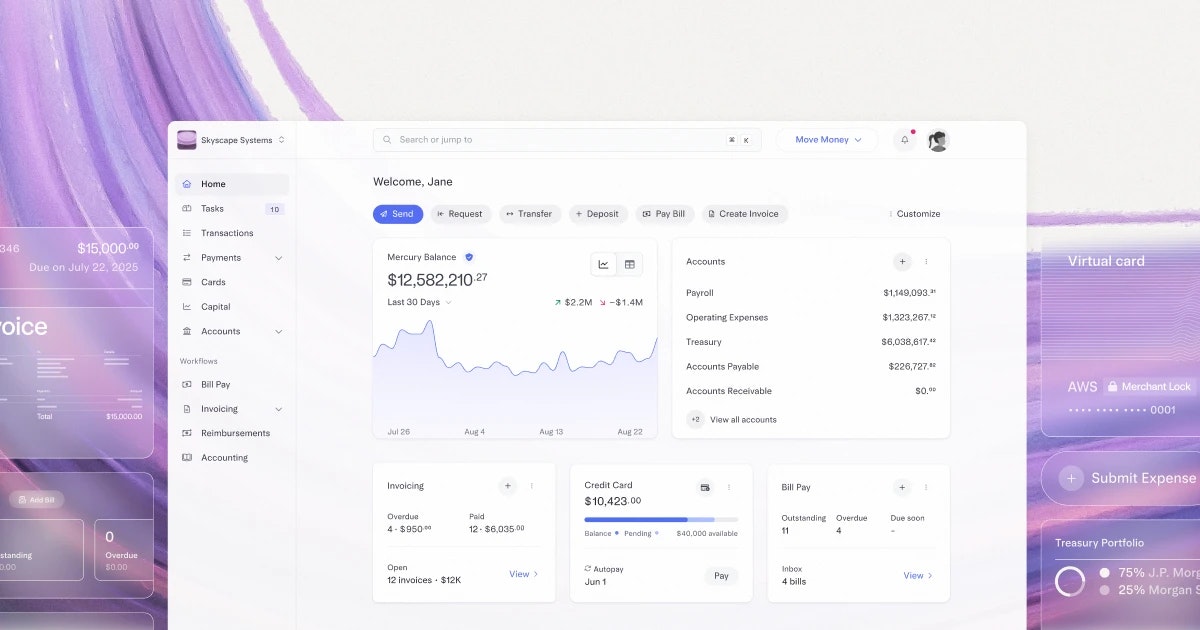
Mercury is one of the default answers when a US startup asks where to put its money. It launched in 2017 aimed squarely at founders who were tired of legacy business banks, slow onboarding, and clunky dashboards, and it built a product that feels closer to a modern SaaS tool than a bank.
For a founder or finance lead, the real question is not whether the interface is nice, because it is. It is whether a fintech layer sitting on top of partner banks is the right home for your operating cash, and where the trade-offs actually show up.
This review is written for founders, finance, and ops leaders evaluating Mercury as their primary business account. We cover what Mercury really is, how the accounts and treasury work, what the free and paid tiers include, where it is genuinely strong, and the honest limits, from US-only eligibility to the lack of cash deposits.
We also cover who should look elsewhere, and five alternatives worth comparing before you move your money.
What is Mercury?
Mercury is an online business banking platform, built by Mercury Technologies, a company founded in 2017 and headquartered in San Francisco. It is worth being precise here: Mercury is a fintech company, not an FDIC-insured bank.
The banking services, meaning the accounts, cards, and deposit insurance, are provided by its partner banks, Choice Financial Group and Column N.A., both Members FDIC. Mercury builds the software and the experience that sits on top.
The core product is a business checking and savings account with no monthly fee, no minimum balance, and no overdraft fees on the base plan.
From there Mercury layers on the tools a startup finance stack needs: domestic and international wires and ACH, virtual and physical debit cards with spend controls, bill pay and invoicing, accounting integrations with QuickBooks, Xero, and NetSuite, and a developer API for programmatic payments.
Two things set Mercury apart. The first is insurance: through partner banks and their sweep networks, eligible deposits get up to $5M in FDIC coverage, about 20x the usual $250,000. The second is treasury: idle cash can be moved into money market funds to earn yield.
Mercury also offers the IO credit card (with 1.5% cashback) and working capital products, though those sit outside the core account.
How Mercury works
Getting started runs entirely online. You apply with your business details, and because Mercury targets startups, it is comfortable with C-corps, LLCs, and venture-backed entities, including many that are newly formed.
Approval is usually fast, and there is no personal guarantee or credit check for the account itself. Once open, you get checking and savings, plus the ability to spin up multiple accounts to organize cash, for example separating payroll, taxes, and operating funds.
Day to day, most of the work happens in a clean dashboard. You send wires and ACH, issue debit cards to teammates with per-card limits, schedule bill payments, and send invoices. Payments can be automated through the API, which is a real draw for technical teams that want to move money programmatically. Accounting sync pushes transactions to your ledger so bookkeeping stays current.
Treasury is a separate flow. Once your total Mercury balance crosses $250,000, you can allocate cash into two lower-risk money market funds, a J.P. Morgan US Treasury fund and a Morgan Stanley ultra-short portfolio, and set automated transfers between them and your checking.
The rough edges are worth knowing. Because Mercury is not a chartered bank, you cannot deposit physical cash or paper checks at a branch, support is online only, and some businesses find the fintech model less reassuring than a traditional bank when something goes wrong.
Mercury key features
Mercury pricing
Mercury, Ramp, Relay, Bluevine, and Brex all publish list prices, and each offers a free plan. Brex Essentials is free, Premium is $12 per user per month, and Enterprise is a custom quote.
The cheapest paid list prices are per seat: Brex Premium at $12 and Ramp Plus at $15 per user per month. Flat monthly plans start higher: Mercury Plus is $35 per month, or $29.90 with annual billing, while Relay Grow and Bluevine Plus are each $30 per month.
The price jumps at the top named tier, where Mercury Pro is $350 per month, or $299 billed annually, Relay Scale is $90 per month, and Bluevine Premier is $95 per month. Treasury sits apart from those subscriptions: a fee of 0.15% to 0.6% once balances reach $250,000.
| Plan | Price | Best for |
|---|---|---|
| Mercury Free | $0/mo | Checking and savings, up to $5M FDIC |
| Mercury Plus | $35/mo or $29.90/mo annual | Unlimited 1099s, $1 ACH, 500/mo API, six months Xero, LegalZoom |
| Mercury Pro | $350/mo or $299/mo annual | Relationship manager, free ACH invoicing, unlimited API, NetSuite |
| Mercury Treasury | 0.15% to 0.6% fee, $250,000 min | 3.20% to 3.46% ($250K to $2M); up to 3.91% (Sep 2026) |
| Mercury international wires | Free SHA; $15 OUR; 1% non-USD | USD card payments and standard payments are free |
| Brex business account | Free | No monthly fee and no minimums |
| Brex Premium | $12 per user/mo | Custom expense policies and live budgets; Enterprise is quote-only |
| Ramp Free | $0 per user/mo | Corporate cards and expense automation |
| Ramp Plus | $15 per user/mo | Advanced automation above the free plan |
| Ramp Enterprise | Custom quote | Custom plan above Ramp Plus |
| Relay Starter | $0/mo | Up to 20 checking accounts |
| Relay Grow | $30/mo | Paid plan above free Starter |
| Relay Scale | $90/mo | Highest published Relay plan |
| Bluevine Standard | Free | 1.3% APY on balances up to $250,000 |
| Bluevine Plus | $30/mo | Paid plan above free Standard |
| Bluevine Premier | $95/mo | 3.0% APY on all balances |
Mercury pros and cons
What we like
- Free base plan with no minimums, plus a clean, fast product founders actually enjoy using.
- Up to $5M FDIC through partner banks and sweep networks, about 20x the standard coverage.
- Treasury yield, a developer API, and multiple sub-accounts suit technical, cash-conscious teams.
What could be better
- US businesses only, so no accounts for companies without a US entity.
- Not a chartered bank, so no physical cash or paper check deposits and online-only support.
- Lending and credit products are limited compared with a full-service bank.
Who Mercury is for
Mercury is a strong fit for US-based startups, small businesses, and scaling companies, especially venture-backed and technical teams that value a clean product, fast onboarding, and an API.
If you want free business banking, generous FDIC coverage through sweep networks, and a place to park idle cash at yield, Mercury is one of the best options available. Founders who run everything from a laptop and never need a branch will feel right at home.
It is a poor fit in a few clear cases. It serves US businesses only, so companies without a US entity are out. If your business handles physical cash or paper checks, the lack of cash deposits is a dealbreaker, since Mercury is not a chartered bank with branches.
Companies that need deeper lending, a large line of credit,, or a long banking relationship for loans may find the fintech model limiting. And teams whose main need is corporate cards and deep spend management, rather than a bank account, may get more from Brex or Ramp.
Best Mercury alternatives
If Mercury is not the right fit, these are the closest options.
| Tool | Best for | Starts at | |
|---|---|---|---|
| Mercury | US startups and scaling companies that want free, modern business banking with treasury yield and an API. | Free ($0/mo) | Visit → |
| Brex | Venture-backed startups and larger companies that want corporate cards plus spend management in one place. | Free Essentials plan | Visit → |
| Ramp | Finance teams focused on cost control, corporate cards, and automating expenses and bill pay. | Free ($0 per user/mo) | Visit → |
| Relay | Small businesses and bookkeepers running Profit First or envelope-style cash management. | Free Starter ($0/mo) | Visit → |
| Bluevine | Small businesses that want interest-earning checking and access to a line of credit. | Free Standard (1.3% APY up to $250,000) | Visit → |
The bottom line
Mercury has earned its place as a default startup bank. For a US company that wants free, modern business banking, fast onboarding, generous FDIC coverage through partner banks, and a place to earn yield on idle cash, it is one of the best options on the market, and the product is a pleasure to use day to day.
The trade-offs are structural, not cosmetic. Mercury is a fintech, not a chartered bank, so there are no branches, no cash deposits, and lending is limited, and it serves US businesses only. Choose Mercury if those limits do not affect you, and for most software startups they do not.
If you mainly need corporate cards and spend control, compare Brex and Ramp; if you want to organize cash across many accounts, look at Relay; and if interest-earning checking with a line of credit matters more, Bluevine is the stronger pick.
Frequently asked questions
How much does Mercury cost?
Is Mercury a real bank?
Is Mercury safe and FDIC insured?
Does Mercury pay interest or yield?
What are the best Mercury alternatives?
Sources
Prices and plan details come from each vendor's own pricing page, re-checked by the Toolradar pricing tracker.
- Mercury pricingchecked Sep 2026
- Brex pricingchecked Sep 2026
- Ramp pricingchecked Sep 2026
- Relay pricingchecked Sep 2026
- Bluevine pricingchecked Sep 2026
Some offers on this page may be paid placements or contain affiliate links.
Get the Finpresso brief
Free daily newsletter, read in 5 minutes.
Subscribe free