
Alstom Lost a Quarter of Its Value in One Day After Six German Train Contracts Turned Into Money Losers
Alstom cut its full year guidance for the second time this year after six Coradia Max regional train contracts in Germany turned loss making, and its shares closed down about 26% in Paris.

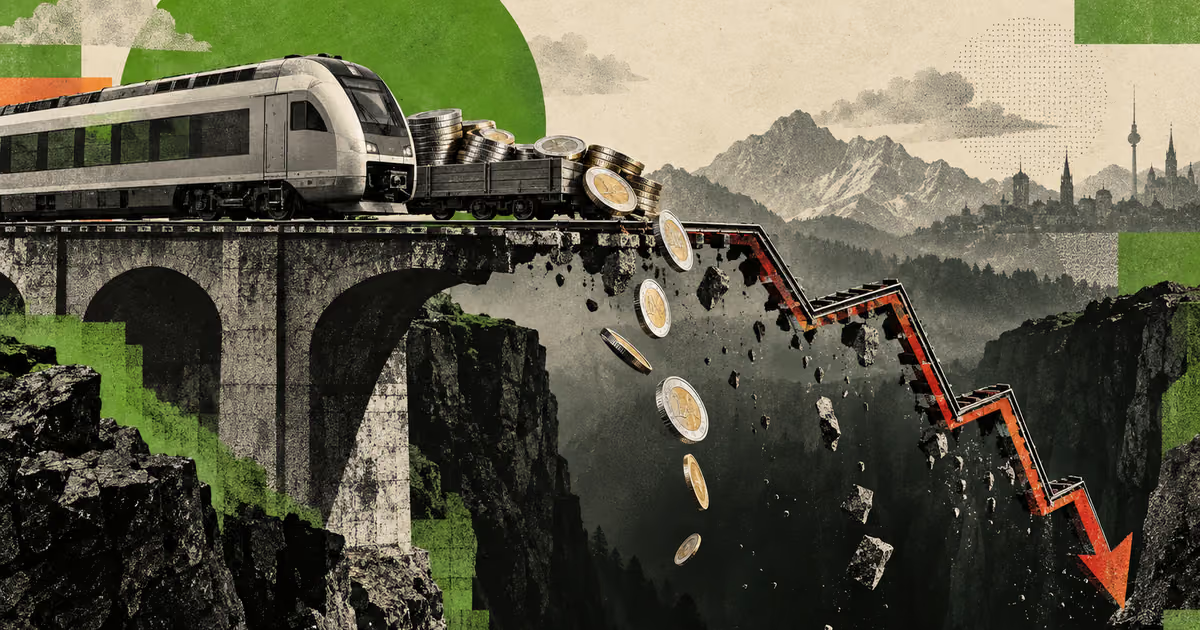
In April, Alstom brought in a new chief executive who promised the train maker would finally get execution right. On Monday, the company admitted that six regional train contracts for German states, worth around 5 billion euros and meant to drive this year's growth, are all losing money.
The market's verdict was brutal. Shares fell as much as 31% in Paris, sat at the bottom of the STOXX 600 and closed down about 26%. The stock has now lost more than half its value this year.
A forecast in pieces
Alstom cut its full year guidance for the second time this year. Its adjusted operating margin for the year to March is now expected at about 1%, down from about 6.5%. Free cash flow, previously promised to be positive, is now expected at minus 1.5 billion euros. Car production drops to about 4,000 from 4,400 to 4,500, and organic sales growth slips to low to mid single digits from about 5%.
Citi analysts said that cash outflow equals roughly 20% of Alstom's market value.
The first half shows where it went wrong. Sales rose 3% to 9.3 billion euros, but the adjusted operating margin swung to about minus 4% from plus 6.4% a year earlier, and free cash flow came in at minus 1.248 billion euros. Orders reached 11.0 billion euros in the half. Demand is not the problem.
One train, six contracts
The problem is the Coradia Max. Alstom has six contracts for the regional trains with German states including Baden-Wuerttemberg and Lower Saxony, and they were supposed to be its biggest production ramp of the year.
Earlier in 2026, technical issues forced Alstom to pause production and retrofit trains it had already built. Then a review found the testing plan had to be redone to satisfy validation and homologation rules. Because the contracts were built so that certifying the first train would support approval of the other five, the delay hit all six at once. First certification is now expected only in March 2028, with trains entering service from 2028 into early 2030, Reuters reported.
Management blamed technical challenges, weak project management and very stringent contract terms, with severe penalties in two of the six. The roughly 950 million euro first half hit covers both extra costs and customer penalties. Coradia Max production is being held near zero this year until testing is done.
Finance chief Bernard Delpit described a "domino effect" on other German projects. Chief executive Martin Sion's review found "not only were there engineering issues, but the organization surrounding project management was neither efficient nor effective," Delpit said. Sion pointed to "problems in development and project management that should have been better" and said he is confident this will be the last rescheduling.
Selling to stay investment grade
To protect its investment grade rating, Alstom plans to cut debt by roughly 2 billion euros by September 2027 at the latest, largely by selling assets. "We have identified the assets and are beginning the process," Delpit said. It also lined up a new 2 billion euro credit facility on top of 1.6 billion euros of cash at the end of September, and it is reorganizing to simplify and cut costs.
Asked whether the French state might raise its stake, Sion said that is not "something that we are discussing today." Bpifrance and Quebec's La Caisse together own about 25% of the company, according to Bloomberg data. The backdrop at home is not helping: France's economy shrank last quarter while inflation hit 3.4%, and its finance minister has warned the country is headed for a wall without a deficit cutting budget.
Monday's warning lands on a long record. Alstom has issued several profit warnings since 2021, and its takeover of Bombardier's rail business left it with low margin contracts. Within weeks of Sion's arrival, it had already scrapped its three year cash flow target and cut its profit forecast once. Full first half results come on 17 November, with a capital markets day planned for the second quarter of 2027.
Some offers on this page may be paid placements or contain affiliate links.
Finpresso: daily AI & finance brief
Free daily newsletter, read in 5 minutes.
Subscribe free