
France's Economy Shrank as Inflation Hit 3.4%, and Its Finance Minister Warns It Is Headed Straight for a Wall
France's GDP unexpectedly fell 0.1% in the third quarter as inflation rose to 3.4% in October, and Finance Minister Roland Lescure warned the economy is headed for a wall without a deficit-cutting budget.

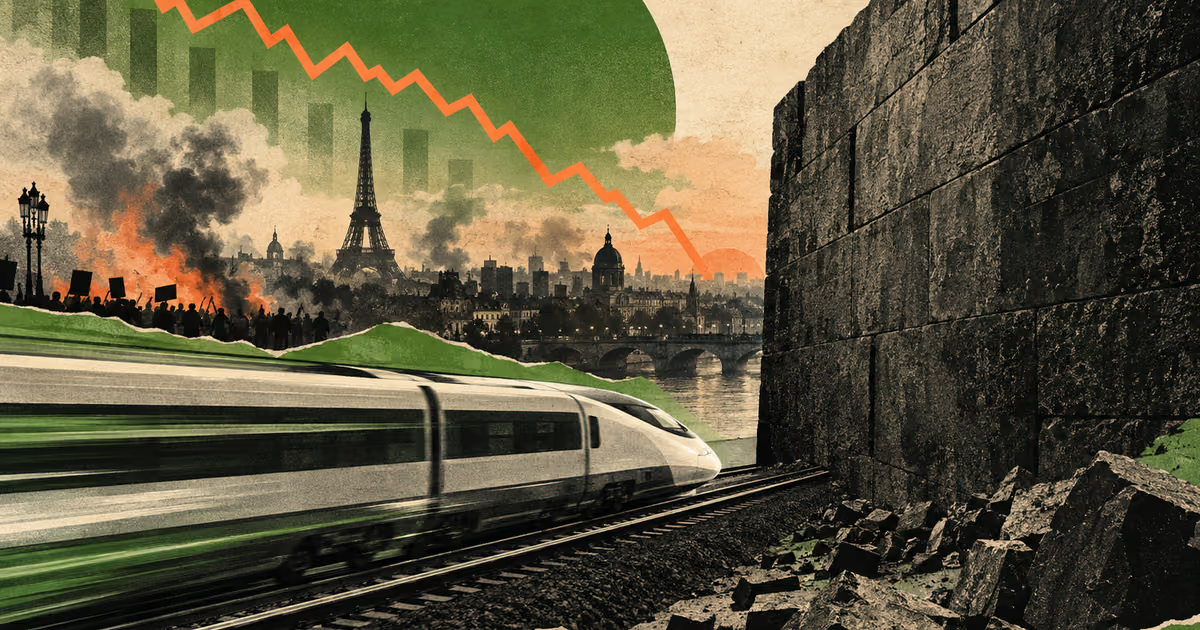
France is getting the worst of both worlds. Its economy unexpectedly contracted by 0.1% from July to September, and inflation climbed to 3.4% in October, the fastest pace since January 2024. Its finance minister is now warning, in plain language, about where that leads.
"For three quarters now, there has been no growth," Roland Lescure said on France Info radio. "France is not heading toward a crisis. But if we fail to achieve the turnaround outlined in the budget, we are headed straight for a wall."
Lescure is trying to pass a 2027 budget with billions of euros in spending cuts, and the numbers give him an argument. They also make his job harder.
A year at a standstill
The Insee statistics agency's figures show a year going nowhere. GDP fell 0.2% in the first quarter and stagnated in the second before this latest dip. Lescure put it bluntly: "as of 2026, the French economy is at a standstill."
The third-quarter detail shows where it hurt. Production slipped 0.1% and investment dropped 0.6%, while foreign trade shaved 0.6 points off growth. Households were the bright spot, with consumption up 0.4%. Inflation was 3.1% in September, so prices sped up just as output fell.
Analysts say the data makes the government's 0.5% growth forecast for the year hard to reach, and possibly even the 0.4% expected by Insee and the Bank of France.
Bond markets, rioting and an election
Investors were already nervous. Worries about high debt and deficits have sent French bond yields soaring in recent weeks, and an underwhelming 2027 budget plan last month fanned concerns that spending would stay high ahead of next spring's presidential election. Polls suggest far-right candidate Marine Le Pen, seen as a fiscal populist, stands a chance in that race.
The streets are not making cuts any easier to sell. Nationwide demonstrations on October 17 degenerated into some of the worst rioting in years. The Yellow Vests and student unions called a new day of protests for Saturday.
The rest of the eurozone kept growing
France's slump stands out because its neighbors did better than expected. Eurostat's flash estimate put eurozone growth at 0.4% in the third quarter, down from 0.6% in the second but double the 0.2% forecast in a Reuters poll. Spain grew 0.6% and Germany 0.2%, while Italy was flat.
That resilience may not hold. Joe Nellis of MHA said the euro area is "showing unexpected resilience," but warned that energy and transport costs will keep rising unless the Middle East crisis is resolved soon. The latest reading on that front is not encouraging, with Brent jumping to $117 after Iran said four tankers hit mines in the Strait of Hormuz.
The European Central Bank held rates on Thursday, and markets are pricing one more hike this year, possibly in December, as energy costs stay high. For France, more expensive borrowing would land on an economy that has not grown all year, with a budget still to pass and an election months away.
Some offers on this page may be paid placements or contain affiliate links.
Finpresso: daily AI & finance brief
Free daily newsletter, read in 5 minutes.
Subscribe free