
Iran Says Four Tankers Hit Mines in Hormuz After the US Declared the Strait Cleared, and Brent Jumps to $117
Iran's Revolutionary Guards said tankers struck mines in the Strait of Hormuz, contradicting a US statement that its forces had cleared the main routes, as Brent hit $117 a barrel and oil headed for a fourth straight monthly gain.

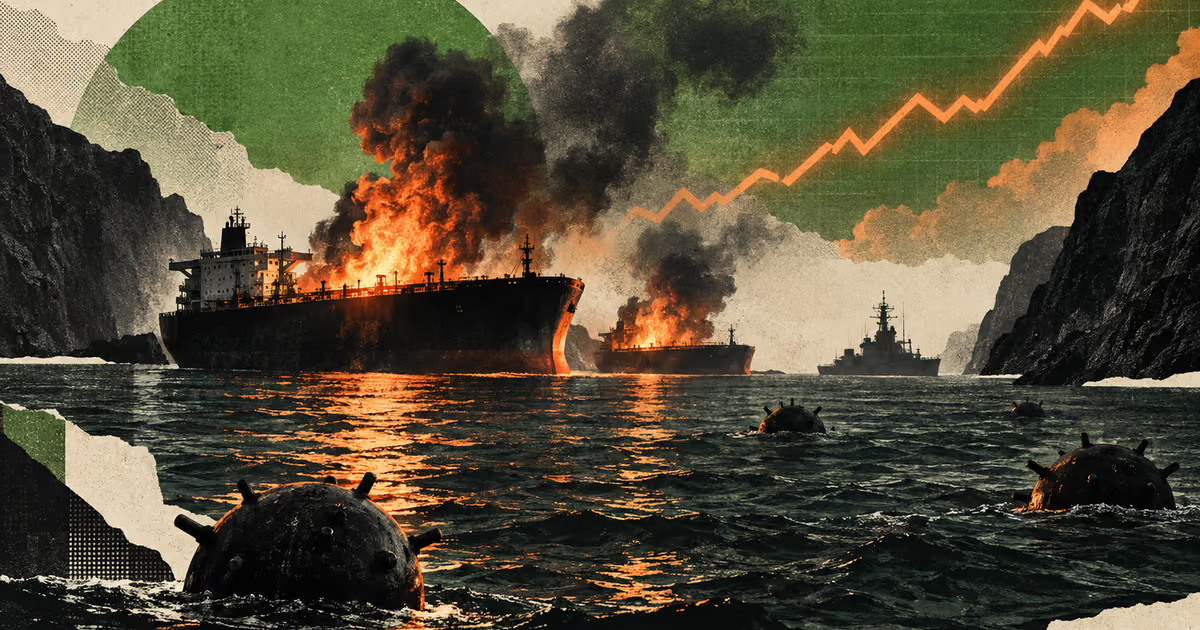
US Central Command said American forces had cleared mines from the main transit routes through the Strait of Hormuz. Iran's answer was a story of burning tankers. The Revolutionary Guards said three tankers caught fire after striking mines on what they called an "unauthorized southern route" near the Omani coast, and Iran's army said a fourth burned east of the strait.
Those are Iranian claims and have not been independently confirmed. The market still took the threat seriously. Brent hit $117 a barrel in Asian trade on Friday, putting oil on track for a fourth consecutive monthly gain.
The Guards turned the episode into a direct challenge to Washington. "Prove the claim that the Strait of Hormuz has been cleared of mines with independent evidence, not a statement," said spokesman Hossein Mohebi. "The reality of the Strait of Hormuz is determined in the air, on land and at sea, not on social media and in America's media war rooms."
A separate attack, with explosives on the hull
Not every report from the waterway came from Tehran. UK Maritime Trade Operations, linked to the Royal Navy, reported that a small boat approached a tanker on the port side and attached two explosive devices to the hull above the waterline, about 25 nautical miles northeast of Khasab, Oman.
The blasts caused an engine room fire that temporarily disabled the vessel. A later update said the crew was safe, the fire was out, there was no environmental impact and the ship was continuing to its next port. It was the agency's third report on Thursday.
The strait used to carry about one fifth of the world's energy supplies. Since the war began in late February, traffic has plunged to single-digit daily passages, and the conflict is now in its ninth month.
Saudi Arabia back in the line of fire
The pressure is not confined to the water. The Houthis said they launched six operations across Saudi Arabia targeting airports and oil facilities, only days after senior Saudi and Iranian officials held a rare meeting in Tehran and agreed to resolve their differences through dialogue.
Saudi authorities have not confirmed those attacks, though they said air defenses intercepted a Houthi drone launched toward the Mecca region. Oil was already at $111 a week earlier, after Houthi attacks on a Saudi oil field near Dammam and a US order for diplomats to leave.
Talks on one track, military options on the other
Washington is sending mixed signals. Vice President JD Vance sent a letter through Qatari mediators to Mohsen Rezaei, head of Iran's Supreme National Security Council, proposing a framework for talks.
President Trump, asked whether he had directed it, said "no." "He asked me what I thought," Trump said, adding that he had told Vance it was OK to go ahead.
Meanwhile, reports say the administration may resume military action after the November 3 midterms. Adm. Brad Cooper, the top US commander in the region, briefed Trump on military options for Iran in a rare in-person White House visit, the Wall Street Journal reported, and the discussion also covered the continuing US blockade.
That timing is what traders are pricing. Oil's latest climb reflects fears that an escalation is coming once the midterm votes are cast, with a Vance letter on one side of the ledger and burning tankers on the other.
Some offers on this page may be paid placements or contain affiliate links.
Finpresso: daily AI & finance brief
Free daily newsletter, read in 5 minutes.
Subscribe free