
France's Worst Riots in Years Hit Days Before a Budget Vote That Bond Traders Are Watching Very Closely
About 550,000 people marched across France on Saturday and nearly 2,400 were arrested as protests over living costs and schools turned violent, two days before lawmakers vote on a budget seeking €54 billion in savings. French bond yields are at a 24-year high.

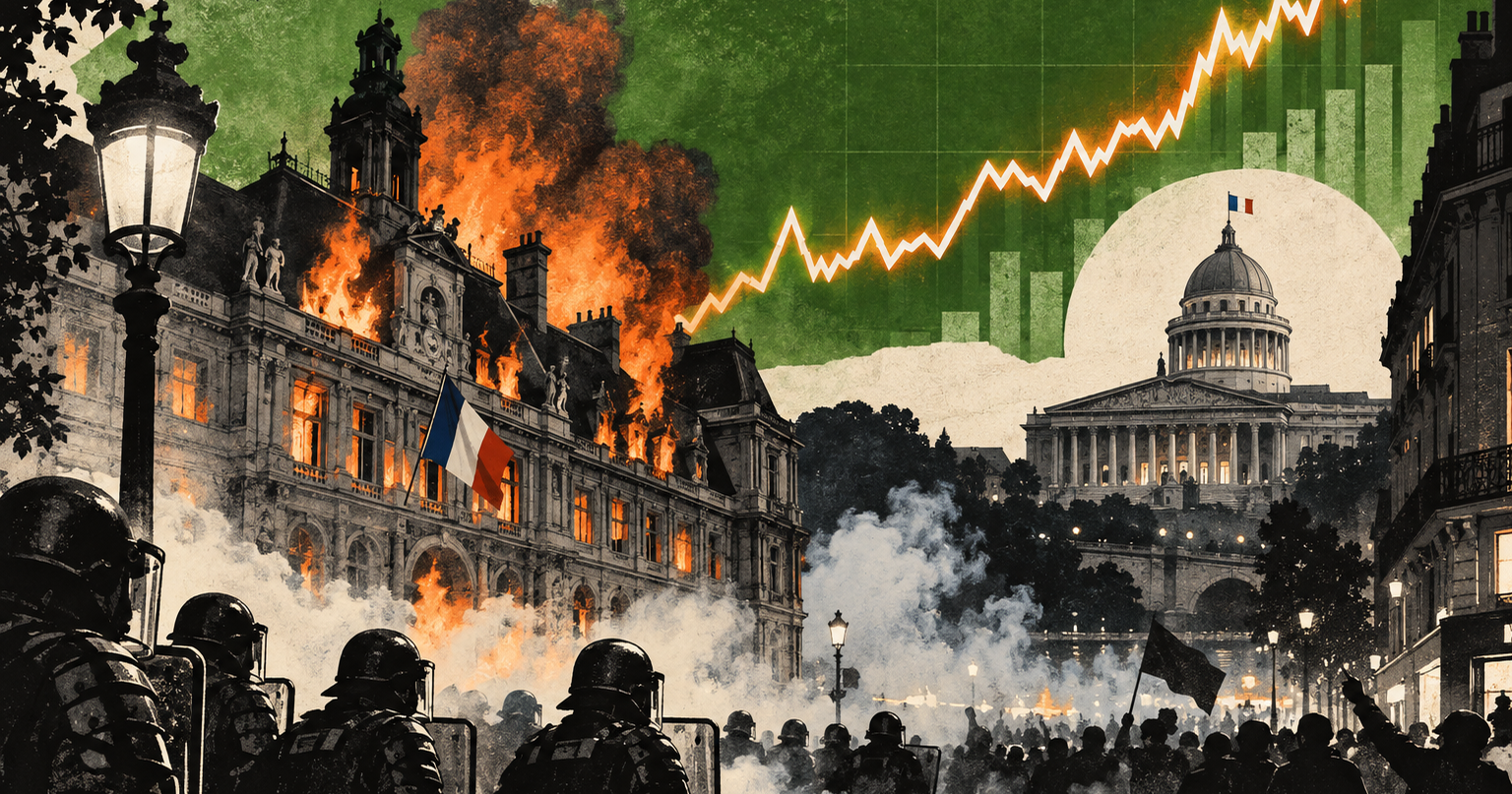
France just had its worst riots in years. On Saturday about 550,000 people marched in scores of cities, 110,000 of them in Paris, over high living costs and crumbling public services. Almost 2,400 were arrested, shops were looted, and nearly 1,000 police and gendarmes were injured, according to the interior ministry.
The timing could hardly be worse. On Tuesday the National Assembly votes on the first part of a budget meant to find €54 billion ($61 billion) in savings. The government has to sell austerity while the street is on fire, and bond markets already treat French debt as the weak link in Europe.
A town hall in flames
The 143-year-old town hall in Limoges was set ablaze and largely destroyed. "There was a clear, premeditated intention to burn down the town hall, and the people inside feared for their lives," said Mayor Guillaume Guérin. Protesters forced their way into Marseille's city hall, and Lyon's tourist office was set on fire.
Interior Minister Laurent Nuñez said several hundred shops suffered considerable damage, and Bordeaux Mayor Thomas Cazenave said up to 100 stores were looted there. One protester died of cardiac arrest during the Paris demonstrations, police said. On Sunday police fired tear gas and stun grenades at Place de la République. Business losses are running into the hundreds of millions of euros.
The unrest followed a month-long student movement over teacher shortages and school conditions, on top of union anger.
Emmanuel Macron went on television Sunday. "Looking at these images, we have all asked ourselves: What was going through their minds? How can French people do this to France?" he said. "Nothing justifies it, nothing explains it, nothing excuses it." He promised an "uncompromising" response to "agitators from ultra-left fringe groups, joined by numerous delinquents," but stopped short of a state of emergency or curfew. Prefects and mayors can ban some gatherings. He ordered a review of intelligence or police failings and asked the government to bring students, teachers, lawmakers, unions and business leaders together this week for "concrete proposals." Economy minister Roland Lescure promised support for business owners.
His rivals pounced. Marine Le Pen, the far-right frontrunner for next year's presidential race, said the government is "running on fumes, exhausted and disoriented." Jean-Luc Mélenchon, also running, said Macron must answer the protesting high-school students and warned of "events that will eventually become uncontrollable."
The math, and the market
Prime Minister Sébastien Lecornu's minority government wants the 2027 budget to cut the deficit to 5% of GDP from 5.4%. France's debt hit a record €3.6 trillion in the second quarter, 119% of GDP, the highest ratio since just after World War II, and it is getting costlier as rates spike worldwide.
Traders noticed. Early Monday the 10-year French OAT yield rose 8 basis points to 4.86%, while Germany's 10-year sat flat at 3.41%, Business Insider reported. French yields are at their highest in 24 years. "French OATs continue to be the punching bag in the ongoing selloff in sovereign bond markets," said Elias Hilmer of Capital Economics. He expects the French-German gap to widen from about 140 basis points to 200 by the end of 2027 while most other eurozone gaps narrow, and thinks the ECB may be reluctant to step in if yields rise on genuine fiscal worries. That echoes Christine Lagarde's message that France has to fix its debt at home.
What Tuesday decides
Ninety One warned that if France fails to pass the budget, the deficit could top 6% of GDP next year, more than double the EU's 3% limit. Eurasia Group's Mujtaba Rahman put it bluntly in a New York Times op-ed: "France, truly, is on the brink." In his view, "If his government fails to pass the budget, the cost of servicing French debt may explode," and France could be forced to seek IMF help and pray for the ECB's. He also sees an exit this week: Le Pen could order her allies to abstain and let the budget through.
Even a win only buys time. Sahil Mahtani of Ninety One noted that next year's presidential election could be followed by another parliamentary election with no clear majority, dragging the uncertainty into 2028. ING's Charlotte de Montpellier said real improvement needs pension reform, which is "highly unpopular." Le Pen has vowed to roll the retirement age back to 62, and Mélenchon is campaigning on the central bank cancelling its holdings of French debt.
Some offers on this page may be paid placements or contain affiliate links.
Finpresso: daily AI & finance brief
Free daily newsletter, read in 5 minutes.
Subscribe free