
The AI Trade Cracks as Korea's KOSPI Plunges 6% and Samsung Sinks 10% on Fears of Costlier Money
Korea's KOSPI fell more than 6% and Samsung dropped 10% as chip stocks across Asia sold off on worries that high and volatile bond yields will make the AI spending boom too expensive. AI IPOs and debt deals are getting harder too.
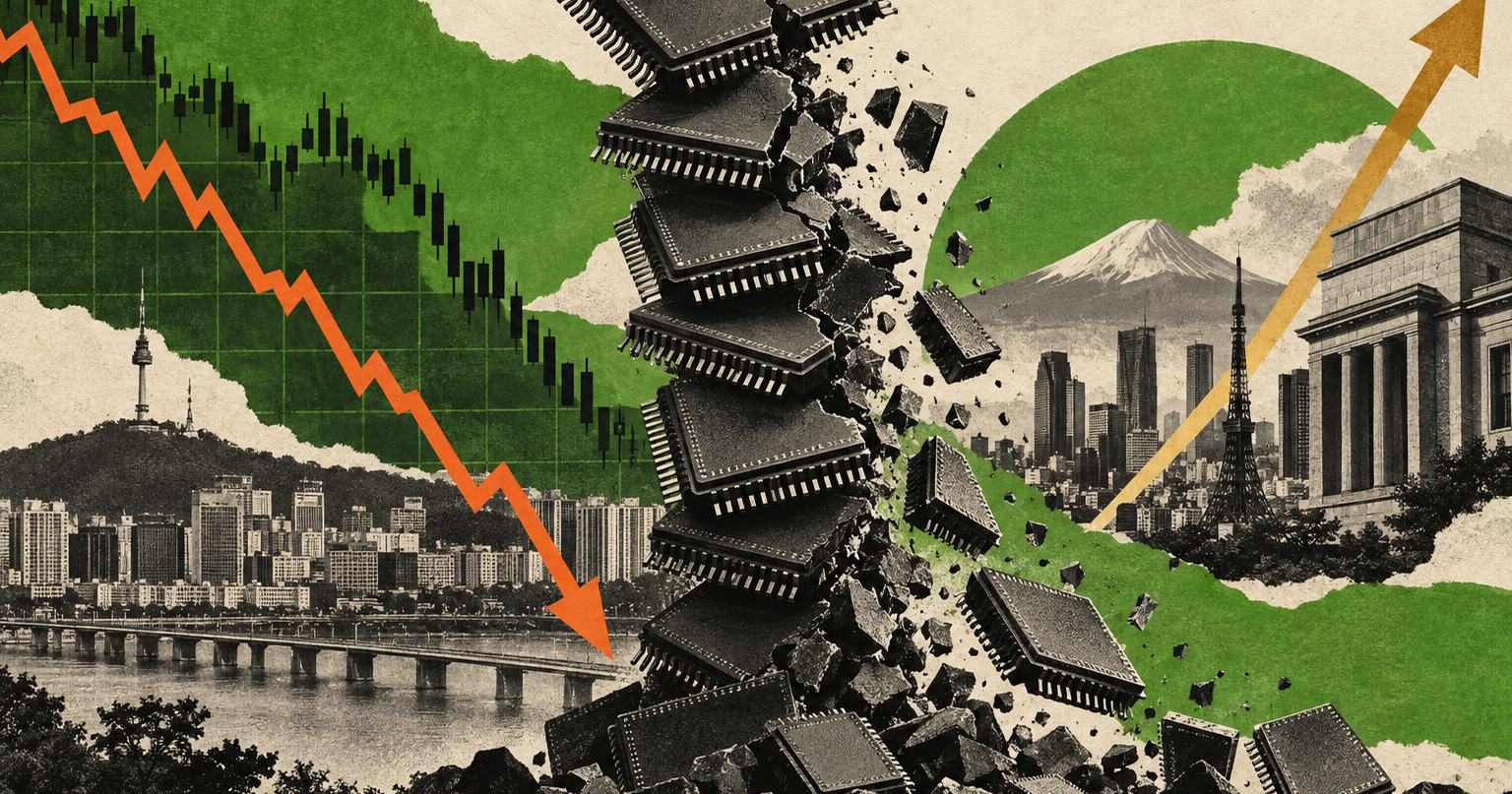
Asia's chip stocks had their worst day in months on Tuesday, and the fear driving it was less about demand for AI than about the price of money. Korea's KOSPI fell more than 6% as selling in chipmakers stretched to a fifth straight day, while Samsung Electronics and SK Hynix dropped 10% and 8%.
In Tokyo, memory maker Kioxia fell 13%. These were the heaviest falls since the end of July, and they are the strongest sign yet that the mood is shifting on what investors have called the trade of the decade, with rising interest rates threatening a spending spree bigger than America's historic railroad boom.
Seoul and Tokyo take the hit
On Monday, the Philadelphia semiconductor index fell 2.7%. Asia's selling went much further. The KOSPI is now on its longest losing streak in more than two years and sits a quarter below its July highs. Shanghai's STAR Market is down more than a third from its July peaks.
The damage spread. MSCI's broadest index of Asia-Pacific shares outside Japan fell more than 2% to its lowest since late July, the Nikkei sank 2.6% after a holiday, and Nasdaq futures slipped 0.77%.
Nearly four years after ChatGPT launched, cash has poured into chipmakers, data centre owners and cable companies. That build-out depends on cheap capital, and capital is no longer cheap. The 10-year Treasury yield sat around 5.19% on Tuesday, just off the 24-year high of 5.364% reached last week, and Pimco's bond chief has warned it could climb to 6%. Energy-driven inflation and ballooning government debt have pushed borrowing costs to multi-decade highs worldwide.
Damien Boey of Wilson Asset Management in Sydney said the swings matter as much as the level. "The most important development has been not just bond yields going up, but the volatility for bonds ... and that's starting to work its way out through asset pricing across the board," he said. His read on what comes next: "maybe AI capex just comes off the boil a little bit, and maybe a few players are casualties in that."
The warnings pile up
Big institutions are saying similar things. On Monday, BlackRock's research arm cut its outlook on US stocks to neutral, pointing to "potential volatility around the AI buildout," and turned bullish on short-term Treasuries. On Tuesday, the IMF's financial stability report warned that "the consequences of an AI correction could be global," and flagged growing evidence that AI capability investments and the economic gains from them may not be as big as expected.
Even the industry is talking about money. Broadcom's CEO said in Singapore on Monday that capital was the biggest constraint on growth.
Funding gets harder
The strain is showing in deals. Firmus, an Nvidia-backed data centre operator, shelved a $5 billion IPO in Australia last week as investor interest shrivelled. Credit investors are getting picky about AI debt, too.
Tencent was selling dollar and dim sum bonds on Tuesday, with at least $4.5 billion expected and its 10-year dollar notes guided at about 1.15 percentage points over Treasuries. Last month SoftBank sold the biggest high-yield debt pile ever, paying as much as 9.75% on $4.5 billion of 7.5-year debt.
More tests are coming. Big US banks including JPMorgan, Goldman Sachs, Citi and Wells Fargo report on Tuesday, US inflation data lands Wednesday, and markets price about an 80% chance the Fed holds rates this month.
Shakeout, not the end
Not everyone sees a collapse. Meta shares jumped 3.4% on Monday on a new AI model, a reminder that investors still reward AI news they like.
Marc Velan of Lucerne Asset Management in Singapore said the brutal session in Korea said more about positioning and the cost of capital than about AI demand. "I suspect we're entering the next phase of the AI cycle, where markets increasingly focus on monetisation and returns on invested capital. I wouldn't call this the end of the AI trade. But Korea could be an early warning of a broader shakeout."
Some offers on this page may be paid placements or contain affiliate links.
Finpresso: daily AI & finance brief
Free daily newsletter, read in 5 minutes.
Subscribe free