
Kick Review 2026: AI Bookkeeping Pricing for Small Business
What Kick's free, Basic, Plus and Advanced plans cost, where the 250-transaction cap bites, what the AI ledger does and does not do, and four bookkeeping options priced against it.

Kick is worth it in 2026 for a cash-basis small business that wants its books categorized by software, reviewed at year end by its own CPA, and priced like software rather than like a bookkeeper. The free plan handles 250 transactions a year with a P&L and balance sheet; Basic costs $40 a month for unlimited categorization, reconciliation and statement sync; Plus costs $100 a month for multi-entity and accrual books; Advanced costs $300 a month. Kick does not file taxes or assign you a bookkeeper. Choose Digits for invoicing and bill pay inside the ledger, Puzzle for startup metrics, and Bench or Pilot when a human must own the close.
Key factsBest for: Cash-basis businesses and multi-entity owners who will…
- An AI ledger that categorizes in real time, builds the year-end tax package and opens the books to AI assistants.
- Free plan: Yes, 250 transactions a year
- Entry paid plan: Basic, billed monthly or annually
- Team members: Unlimited on every plan
- Bookkeeper or tax filing: Not included on any plan
Pros
- Free plan covers 250 transactions a year with P&L, balance sheet, receipt matching and invoicing.
- Basic adds unlimited categorization, reconciliation, statement sync and MCP and CLI access for ChatGPT, Claude and Cursor.
- Unlimited team members on every plan, and unlimited entities on Plus with each new one free for its first 250 transactions.
Cons
- No bookkeeper, monthly close or tax filing on any plan, so someone on your side must review the books.
- Annual billing on Basic equals twelve monthly payments, so paying upfront brings no discount.
- Each extra entity on Plus adds a monthly fee once it passes its free 250 transactions, which can double the bill for a three-company owner.
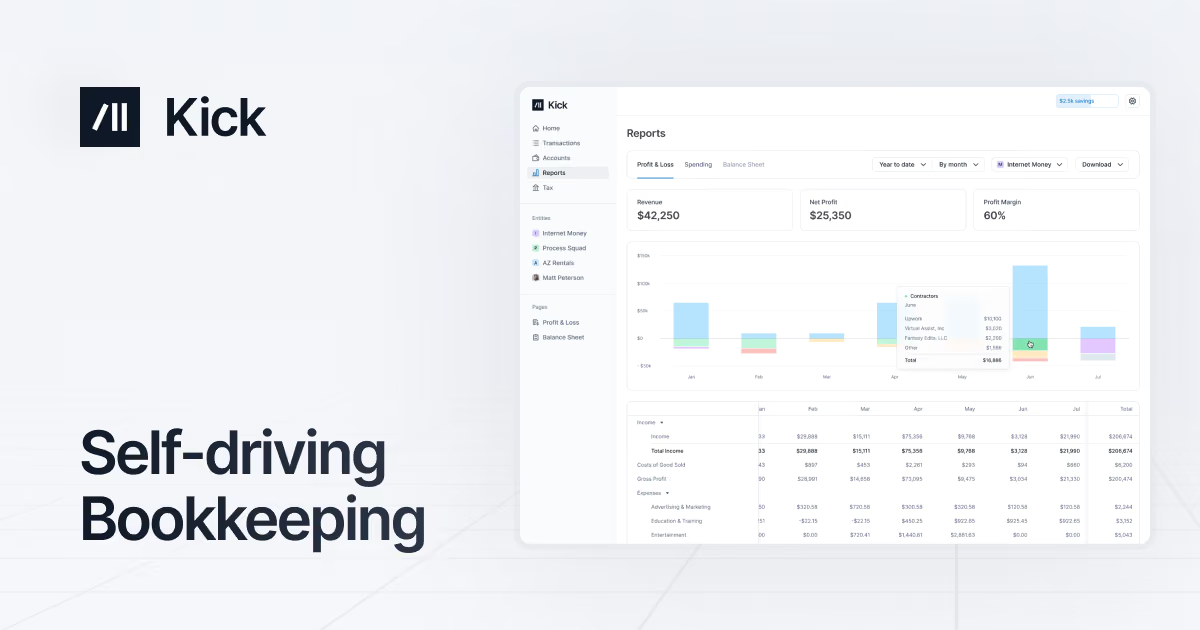
Bookkeeping for a small business splits into two purchases: software that sorts transactions, and a person who signs off on them. Kick sells the first and leans on your accountant for the second, which is why its prices sit between a QuickBooks subscription and a Bench retainer. The company describes the product as an agentic ledger that does your books with you, and says 5,000+ business owners and accountants use it, backed by $20 million raised. This review is for an owner deciding whether an AI ledger can replace a monthly bookkeeping bill, and for the accountant who will inherit the file.
Finpresso data: Toolradar, the software directory we run, evaluated 279 accounting tools for its ranking updated October 15, 2026, and 51 of the 200 it ranks have a free plan. Kick is one of them, so the question is not whether you can start free but when the 250-transaction cap pushes you onto a paid plan. The accounting ranking has the field, and Kick's Toolradar profile holds its numbers.
What is Kick?
Kick is a cloud ledger that connects to bank, card, payment and payroll accounts, categorizes every transaction in real time with a model that experts review, matches receipts and produces a P&L, balance sheet, trial balance and a one-click year-end tax package for your CPA. Integrations named on the pricing page include Stripe, PayPal, Mercury, Plaid and Ramp, with 50+ more, and Gusto from Basic upward. Invoicing with custom invoices, templates and invoice emails is included on every plan, including Free, while AR and AP aging summaries start on Plus.
Two things set it apart from a classic ledger. First, the deduction logic: Kick says it handles home office, vehicle and travel deductions automatically and lets you write custom rules for your own patterns. Second, the agent surface: Basic and above expose an MCP server and a CLI, with ChatGPT, Claude and Cursor listed as integrations, so an owner or an accountant can query and work the books from an AI assistant rather than from the web app.
What it is not: a bookkeeping service. No plan assigns a named bookkeeper, performs a monthly close for you or files a return. Accountants get their own tiers, with 10% off on Starter for 1 to 19 client licences and 50% off on Partner for 20 or more, which is the route if your CPA wants to run Kick for you. Our online bookkeeping services ranking covers the human-led alternatives.
How Kick works
Connect accounts, let the categorization run and review the exceptions. Kick learns from corrections and from the rules you write, so the review queue shrinks over time. Receipts are matched to transactions, vendors are tracked for monthly spend, and revenue can be split into custom lines across income sources. At year end you download the tax package and hand it to your preparer.
The plan ladder follows accounting complexity rather than company size. Free and Basic are single-entity, cash-basis ledgers; Basic adds reconciliation, statement sync and a universal importer for history from another system. Plus is where accrual books, classes, AR and AP automation and multiple entities arrive, with new entities free for their first 250 transactions a year and billed monthly after that. Advanced adds consolidation and revenue recognition, with prepaid and accrued schedules and multi-book in beta.
Every plan includes unlimited team members at no extra charge, which matters for a business that wants its accountant, a partner and an assistant in the file. Pricing on the vendor page shows Basic billed annually or monthly, Plus billed quarterly or monthly, and Advanced billed monthly only.
Kick key features
Kick pricing
Methodology: every price here was checked on the vendor's own pricing page on October 18, 2026, in US dollars, from the business plans rather than the accountant tiers. Kick's pricing page lists Free at $0 a month for 250 categorized transactions a year, Basic at $480 billed annually or the same total spread over twelve monthly payments, Plus at $100 a month billed monthly or quarterly, and Advanced at $300 a month billed monthly. The annual and quarterly options match twelve monthly payments, so there is no prepayment discount to chase.
The hidden line is entities. On Plus, each additional entity is free until it passes 250 transactions in a year, then costs $50 a month, so an owner with three active companies pays $200 a month on Plus, double the base fee. Accountants pay 10% less on Starter and 50% less on Partner with a 20-licence commitment, which can make Kick cheaper through your CPA than direct.
Against the field: Digits Essentials costs $65 a month, with Core above it, both with a 30-day free trial, bill pay and invoicing included, and a Pro tier at $250 a month with budget versus actuals, open to sign up. Puzzle Starter costs $30 a month, with 20% off on yearly billing, Core $72, Complete $120 and Scale $360, with an expert-reviewed close from $171 a month. Bench Bookkeeping Light costs $199 a month or $1,910 a year for businesses under $250,000 in revenue, Bookkeeping $399 a month and Bookkeeping plus Tax $649 a month. Pilot Essentials costs $99 a month for up to $100,000 in monthly expenses, with a bookkeeper-led Core plan priced on annual billing and a Custom plan by quote.
Cost scenario we built: a single-entity cash-basis business with about 2,000 transactions a year pays $480 a year on Kick Basic, $780 on Digits Essentials, $360 on Puzzle Starter, and $2,388 on Bench Bookkeeping Light at the monthly rate. The $1,900 gap between Kick and Bench is the price of a human doing the close, and it is the only number that matters if nobody on your side will review the AI's work.
| Plan | Price | Best for |
|---|---|---|
| Kick Free | $0 | 250 categorized transactions a year, P&L, balance sheet, receipts, invoicing, one entity |
| Kick Basic | $40/mo or $480/year | Unlimited categorization, reconciliation, statement sync, universal importer, MCP and CLI |
| Kick Plus | $100/mo, billed monthly or quarterly | Multi-entity, classes, AR and AP automation, accrual ledger; extra entities $50/mo once active |
| Kick Advanced | $300/mo | Consolidation, revenue recognition, prepaid and accrued schedules and multi-book in beta |
| Digits Essentials | $65/mo | AI bookkeeping, invoicing, bill pay, API, mobile apps; 30-day trial |
| Puzzle Starter | $30/mo, 20% off billed yearly | Cash and accrual books, AI suite, 1 seat, 1-click tax report |
| Bench Bookkeeping Light | $199/mo or $1,910/year | Dedicated bookkeeper and tax-ready financials for businesses under $250,000 in revenue |
| Pilot Essentials | $99/mo | Cash-basis books from bank and card data, year-end package, up to $100,000 in monthly expenses |
Kick pros and cons
What we like
- Free plan covers 250 transactions a year with P&L, balance sheet, receipt matching and invoicing.
- Basic adds unlimited categorization, reconciliation, statement sync and MCP and CLI access for ChatGPT, Claude and Cursor.
- Unlimited team members on every plan, and unlimited entities on Plus with each new one free for its first 250 transactions.
What could be better
- No bookkeeper, monthly close or tax filing on any plan, so someone on your side must review the books.
- Annual billing on Basic equals twelve monthly payments, so paying upfront brings no discount.
- Each extra entity on Plus adds a monthly fee once it passes its free 250 transactions, which can double the bill for a three-company owner.
Who Kick is for
Kick fits a cash-basis business past 250 transactions a year whose owner or accountant will review the books, and a multi-entity owner who wants one ledger across companies. It also fits accountants who want to run client books through an AI assistant, since Basic opens the books to ChatGPT, Claude and Cursor through MCP and a CLI. If you are comparing AI ledgers broadly, our AI for bookkeeping ranking places Kick next to Digits and Puzzle.
Skip it if you need someone else to own the close, because no Kick plan includes a bookkeeper or a tax filing; Bench and Pilot sell that, at a multiple of the price. Skip it if invoicing and bill pay are central, where Digits bundles both on Essentials. Skip Plus unless you run more than one entity or need accrual books, since Basic already covers reconciliation and statement sync for a single company.
Owners weighing a service instead of software should read our Pilot review and our Bench alternatives page. A solo operator whose books are mostly a tax problem will get more from our Collective review or our QuickBooks Solopreneur review, and our free accounting software ranking covers the no-cost ledgers Kick Free competes with.
Best Kick alternatives
If Kick is not the right fit, these are the closest options.
| Tool | Best for | Starts at | |
|---|---|---|---|
| Kick | Cash-basis businesses and multi-entity owners who will review AI-categorized books with their own CPA. | Free for 250 transactions/yr | Visit → |
| Digits | Small businesses that want AI bookkeeping with invoicing, bill pay and 12,000+ bank connections in one ledger. | Essentials $65/mo | Visit → |
| Puzzle | Startups that want cash and accrual books with burn, runway and margin metrics on the same screen. | Starter $30/mo, Core $72/mo, Complete $120/mo, Scale $360/mo | Visit → |
| Bench | Owners who want a human bookkeeper to own the monthly close and, on the top plan, file the business return. | Bookkeeping Light $199/mo or $1,910/yr | Visit → |
| Pilot | Funded startups that want a US-based bookkeeper, accrual books and reports on a fixed business day. | Essentials $99/mo for up to $100,000 in monthly expenses | Visit → |


The bottom line
Kick is the right ledger for a small business that will keep a human in the loop on its own terms: the software categorizes, reconciles and packages, and your CPA reviews once a year. Start on Free, move to Basic the month you pass 250 transactions, and go to Plus only for a second entity or accrual books. Budget the per-entity fee before you consolidate several companies into it.
Choose Digits if invoicing and bill pay belong in the ledger, Puzzle if you are a startup that lives by burn and runway, and Bench or Pilot if nobody on your side will review the books and the monthly close must be someone else's job.
This page is general information, not personalized financial advice. Confirm current prices, transaction caps and entity fees with each provider before you commit.
Cite this: Finpresso, "Kick Review 2026: AI Bookkeeping Pricing for Small Business", October 2026.
Frequently asked questions
Is Kick worth it in 2026?
How much does Kick cost?
Does Kick have a free plan?
Does Kick do your taxes or give you a bookkeeper?
Kick or Digits for a small business?
Sources
Prices and plan details come from each vendor's own pricing page, re-checked by the Toolradar pricing tracker.
- Digits pricingchecked Sep 2026
- Puzzle pricingchecked Sep 2026
- Bench pricingchecked Sep 2026
- Pilot pricingchecked Sep 2026
Some offers on this page may be paid placements or contain affiliate links.
Get the Finpresso brief
Free daily newsletter, read in 5 minutes.
Subscribe free