
Lemon Squeezy Review 2026: Fees, Stripe Ownership, Pros and Cons
What Lemon Squeezy really takes per sale once its surcharges apply, what Stripe's ownership means for existing sellers, and when Paddle, Polar, Gumroad or Stripe Managed Payments fit better.

Lemon Squeezy still works in 2026, but it is no longer the place to start a new SaaS. It charges 5% plus 50 cents per transaction with no monthly fee, plus 0.5% on subscription payments, 1.5% on payments from outside the US and 1.5% on PayPal, per its pricing page and fees help article read on November 4, 2026. A $10 monthly subscription paid by a US card loses $1.05 per charge, 10.5%, by our arithmetic.
The bigger issue is direction. In January 2026 the CEO wrote that support had slowed and updates had become less frequent while the team built Stripe Managed Payments, which Lemon Squeezy users will be offered a way to migrate to. Existing sellers can stay for now; new sellers should compare Paddle, Polar and Stripe's own product first.
Key factsBest for: Existing sellers of software and digital products who want…
- A capable merchant of record whose owner is steering users toward Stripe Managed Payments.
- Base fee: 5% + 50¢ per transaction, no monthly charge
- Surcharges: +0.5% subscriptions, +1.5% non-US payments, +1.5% PayPal
- Owner: Stripe, since the acquisition announced in July 2024
- Direction: The team is building Stripe Managed Payments and plans a migration path
Pros
- Sales tax and VAT are collected and remitted for you as the legal seller.
- License keys, signed downloads, subscriptions and usage-based billing in one checkout.
- No monthly fee, and email marketing is free up to 500 subscribers.
Cons
- Surcharges push a $10 US subscription to a 10.5% effective fee, our arithmetic.
- The CEO acknowledged slower support and fewer updates in January 2026.
- The fee is charged on the total including tax, so high-VAT buyers cost you more.
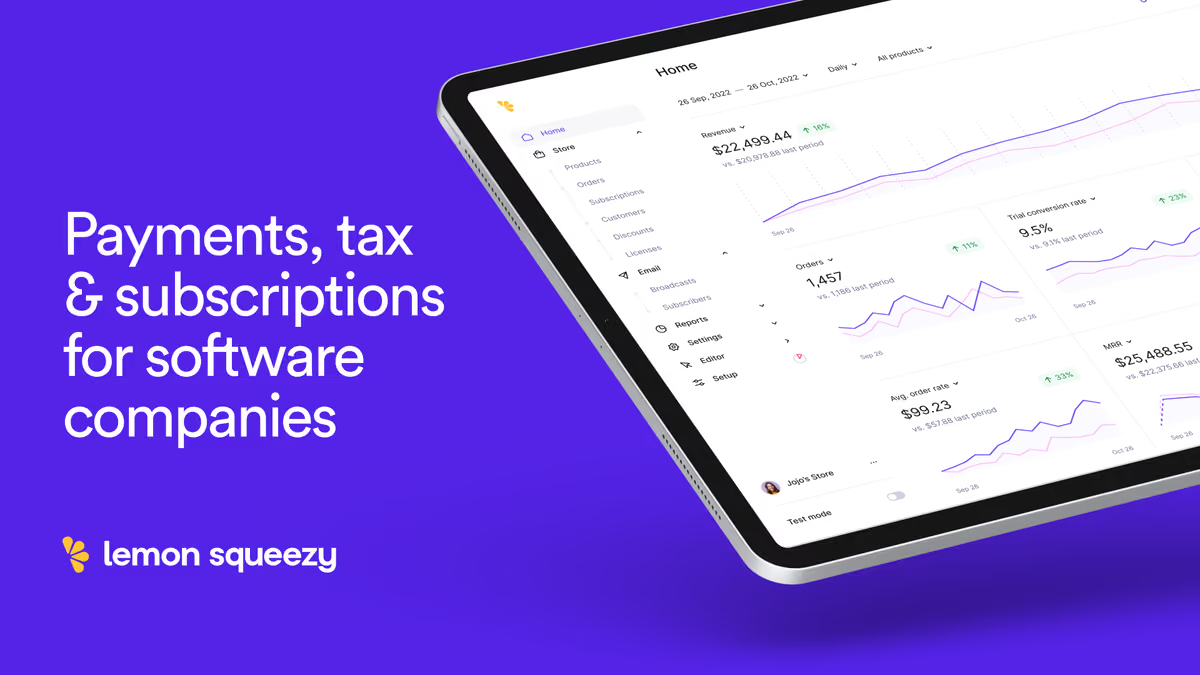
Lemon Squeezy built its name as the friendly merchant of record for indie software and digital products, and the product still does that job. What changed is the company around it.
Stripe announced the acquisition in July 2024, and the CEO's January 2026 update admits the trade-off openly: slower support responses and fewer product updates while the team builds Stripe Managed Payments.
That makes this a review of a product in a holding pattern, and the right answer depends on whether you already sell on it.
This page prices the real fee once the surcharges apply, runs four sale types through it, and compares the result with Paddle, Polar, Gumroad and Stripe Managed Payments.
For card processing without a merchant of record, our Stripe review and the credit card processing fees report cover the raw rates.
Toolradar data: among the 91 subscription billing tools Toolradar tracks as of November 2026, Lemon Squeezy is listed as an alternative to 10 other tools, 12th of 91, and visitors compare it most often with Paddle.
What is Lemon Squeezy?
Lemon Squeezy is a merchant of record: legally, it sells your product to the customer, collects and remits sales tax and VAT, handles fraud screening and pays you the net. That spares a solo founder from registering for VAT in Europe or tracking US state sales tax thresholds.
Around that core it sells subscriptions, license keys for software, secure digital downloads, a hosted storefront, discount codes, an affiliate program and email marketing.
The merchant of record model is why the fee is higher than a plain card processor's.
Stripe's standard online card rate, covered in our Stripe vs PayPal fees comparison, does not include tax filing; Lemon Squeezy's fee does, and the fees help article says the platform fee covers card processing, currency conversion and taxes.
You are paying for tax compliance, not only for payments, so the right comparison is with other merchants of record.
Stripe owns the company, and the January 2026 post describes Stripe Managed Payments as the next version of the same idea on Stripe's infrastructure. At the time of writing it served merchants in more than 35 countries, with public sign-up described as coming soon, so a seller outside those countries has no Stripe path yet.
How Lemon Squeezy works
You create a store, add products, and share a checkout link or embed an overlay on your site. Customers can pay with up to 21 payment methods, including PayPal, and the platform calculates the tax, charges it, and pays out the net to a bank account or PayPal.
Subscriptions support weekly, monthly or yearly billing, trials, upgrades and usage-based pricing, and software sellers get license key issuing and deactivation.
The fee is calculated on the total order value, including tax, and taken when the order is placed. That detail matters in Europe: the help article's own example shows a $20 product sold to a buyer in France, where 20% VAT lifts the total to $24 and the platform fee to $2.06, leaving $17.94.
Your fee rises with the buyer's tax rate even though the tax itself is passed on.
Payouts and marketing tools carry their own fees. Payouts to a US bank via Stripe are free, while non-US bank payouts cost 1% each; PayPal payouts cost a flat fee in the US and 3% capped at $30 elsewhere. Sales recovered through abandoned cart emails cost an extra 5%, and affiliate referrals add 3% for the merchant.
Lemon Squeezy key features
Lemon Squeezy pricing
Lemon Squeezy charges 5% plus 50 cents per transaction on its Lemon Squeezy pricing page, with no monthly fee and custom pricing for high volume or products priced under ten dollars.
The fees help article adds the surcharges: 1.5% for payments from outside the US, 1.5% for PayPal and 0.5% for subscription payments. Both were read on November 4, 2026.
Four sale types, our arithmetic before any tax: a $20 one-time download bought with a US card costs $1.50 in fees, 7.5%. A $10 monthly subscription on a US card costs $1.05 per charge, 10.5%. A $49 monthly subscription paid by a non-US card costs $3.93, about 8%, and $4.67, about 9.5%, if that buyer pays with PayPal.
A $100 yearly plan on a US card costs $6.00, 6%. The fixed 50 cents is why low-priced subscriptions are the most expensive thing to sell here.
Across a whole business the gap compounds. At 200 US subscribers on that same monthly plan, Lemon Squeezy takes about $210 a month. Paddle, which prints 5% plus 50 cents per checkout transaction with no listed surcharges on its pricing page, would take about $200.
Polar's free Starter plan also prints 5% plus 50 cents, adds 1.5% for international cards and has no subscription surcharge, so the same book costs about $200; its Pro plan at $20 a month and 3.8% plus 40 cents brings that to about $176, per Polar's pricing page.
Gumroad charges 10% plus 50 cents on direct sales on its pricing page, about $300 a month for the same subscribers. All figures are our arithmetic from those printed rates, read November 4, 2026; Stripe Managed Payments' rate is not shown in the US view we could read, so check the current price on Stripe's site.
| Plan | Price | Best for |
|---|---|---|
| Lemon Squeezy ecommerce | 5% + 50¢ per transaction | Merchant of record, tax compliance, fraud protection, no monthly charge |
| Lemon Squeezy surcharges | +0.5% / +1.5% / +1.5% | Subscription payments, payments from outside the US, and PayPal payments, in that order |
| Lemon Squeezy email marketing | $0 up to 500 subscribers | Paid monthly or yearly above that, priced by list size |
| Lemon Squeezy payouts | Free to US banks via Stripe | 1% per payout to non-US banks; PayPal payouts 3% capped at $30 outside the US |
| Paddle | 5% + 50¢ per checkout transaction | Merchant of record for SaaS and apps, no monthly or migration fees, bespoke pricing for low-priced products |
| Polar Starter | 5% + 50¢ | Free plan for organizations created from May 27, 2026; +1.5% on international cards |
| Polar Pro | $20/mo + 3.8% + 40¢ | Lower variable rate, prioritized support; Polar puts breakeven near $1,379 a month in sales |
| Polar Growth | $100/mo + 3.6% + 35¢ | For larger sellers; Polar puts breakeven near $5,634 a month in sales |
| Gumroad direct sales | 10% + $0.50 | Merchant of record since January 1, 2025; 30% on sales through the Discover marketplace |
| Stripe Managed Payments | Check the current price on Stripe's site | Stripe's own merchant of record, built by the Lemon Squeezy team |
Lemon Squeezy pros and cons
What we like
- Sales tax and VAT are collected and remitted for you as the legal seller.
- License keys, signed downloads, subscriptions and usage-based billing in one checkout.
- No monthly fee, and email marketing is free up to 500 subscribers.
What could be better
- Surcharges push a $10 US subscription to a 10.5% effective fee, our arithmetic.
- The CEO acknowledged slower support and fewer updates in January 2026.
- The fee is charged on the total including tax, so high-VAT buyers cost you more.
Who Lemon Squeezy is for
Stay on Lemon Squeezy if you already sell there, your checkout works and your buyers are mostly US card payers on annual or one-time purchases, where the effective fee sits between 6% and 7.5%.
Moving a live subscription base is risky, and the January 2026 post promises an easy migration path to Stripe Managed Payments, so waiting for that path is a reasonable plan rather than switching twice.
Start elsewhere if you are launching today. Paddle prints the same base rate without the subscription and international surcharges, which helps a SaaS with many non-US subscribers. Polar suits developers who want lower rates once sales pass its breakeven, and Gumroad suits creators selling courses and downloads who value its marketplace more than the fee.
If you only sell in the US and can file sales tax yourself, a plain processor costs less: see our Square review, the Square vs Stripe breakdown and the best credit card processing companies guide.
Founders outside the US who need a company first can read the Stripe Atlas review.
Best Lemon Squeezy alternatives
If Lemon Squeezy is not the right fit, these are the closest options.
| Tool | Best for | Starts at | |
|---|---|---|---|
| Lemon Squeezy | Existing sellers of software and digital products who want tax handled and can wait for the Stripe migration. | 5% + 50¢ per transaction | Visit → |
| Paddle | SaaS and app companies selling subscriptions internationally. | 5% + 50¢ per checkout transaction | Visit → |
| Polar | Developers and small SaaS teams whose sales are growing past a few thousand dollars a month. | Starter free at 5% + 50¢ | Visit → |
| Gumroad | Creators selling courses, ebooks, templates and memberships who want marketplace reach. | 10% + $0.50 on direct sales | Visit → |
| Stripe Managed Payments | Sellers already on Stripe, or Lemon Squeezy users preparing to migrate. | Check the current price on Stripe's site | Visit → |


The bottom line
Lemon Squeezy is still a working merchant of record, and existing sellers do not need to panic. But the company's own CEO has said support slowed and the roadmap moved to Stripe Managed Payments, so it is a product to keep, not one to adopt.
If you stay, price your plans so the fixed 50 cents and the subscription and international surcharges do not eat a low monthly price.
New sellers should start with Paddle for SaaS, Polar for developer products that will scale, or Gumroad for creator storefronts, or ask Stripe about Managed Payments.
Lemon Squeezy's own listing is on Toolradar, where its average across the 154 web reviews it tracks is 1.2 out of 5. For payment costs without a merchant of record, our PayPal business fees guide is the next read.
Methodology: we read the Lemon Squeezy pricing page, fees help article and January 2026 update, plus the pricing pages of Paddle, Polar and Gumroad and Stripe's Managed Payments documentation, on November 4, 2026. Every fee scenario is our arithmetic on those printed rates, before any sales tax. We did not open accounts or process payments for this page.
This page is general information, not personalized financial advice. Confirm current fees and contract terms with each provider before you switch. Cite this: Finpresso, "Lemon Squeezy Review 2026", November 2026.
Frequently asked questions
Is Lemon Squeezy still worth it in 2026?
Does Stripe own Lemon Squeezy?
What are Lemon Squeezy's fees?
Lemon Squeezy vs Paddle: which costs less?
What is the cheapest Lemon Squeezy alternative?
Sources
Prices and plan details come from each vendor's own pricing page, re-checked by the Toolradar pricing tracker.
- Gumroad pricingchecked Sep 2026
Some offers on this page may be paid placements or contain affiliate links.
Get the Finpresso brief
Free daily newsletter, read in 5 minutes.
Subscribe free