
Quicken Review 2026: Simplifi vs Classic Pricing, Pros, Cons
Every Quicken plan in 2026, from the Simplifi app to the Classic desktop line and the two Business & Personal editions, with year-one totals and the renewal catch.

Quicken is worth it in 2026 if you want your budget, investments and tax reports in one place and you will check the renewal price before year two. The Simplifi app costs $3.99 a month billed yearly, and the Classic desktop software runs from $4.49 a month on Starter to $10.99 on Classic Business & Personal.
Every one of those prices is a first-year offer for new members ordering direct by November 13, 2026, and the renewal rate is not printed. Pick Simplifi for a phone-first budget, Classic Deluxe or Premier if you want desktop software with your data stored locally.
Key factsBest for: Households that want budgeting, investments and tax reports…
- The long-running personal finance brand, now sold as the Simplifi cloud app and the Classic desktop line.
- Cheapest Quicken plan: Simplifi, at about $47.88 for the first year billed yearly, for new members ordering direct.
- Desktop entry point: Classic Starter at $4.49 a month billed yearly, the lowest price for the Windows and Mac software.
- Offer deadline: The first-year prices apply to orders placed directly with Quicken by November 13, 2026.
- Alternatives covered: Monarch, YNAB, Copilot Money, Tiller
Pros
- Simplifi's first year is the lowest paid price among the five tools priced here.
- Classic keeps your data on your own Windows or Mac computer.
- Classic includes Schedule A, B and D and FBAR tax reports built in.
Cons
- Every price is a first-year offer and the renewal rate is not printed.
- Cloud storage is an extra $1.99 a month on the Classic plans.
- Quicken supports banks in the US and Canada only.
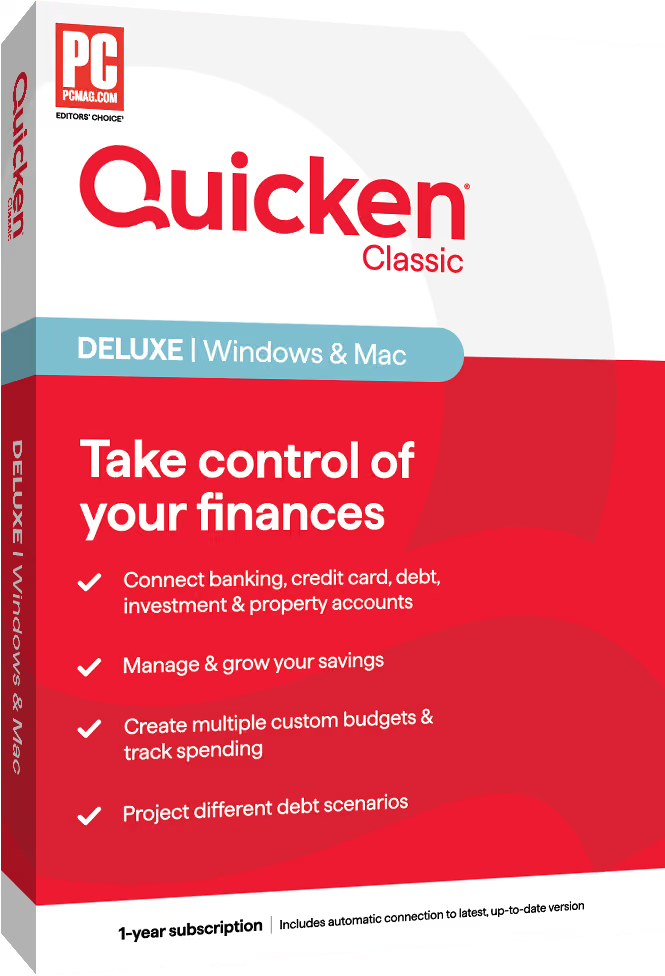
Quicken sells two products under one name: Simplifi, a cloud budgeting app for web and mobile, and Quicken Classic, the Windows and Mac software the brand was built on. Each line has its own business edition, which makes six plans, and the right pick depends more on where you want your data than on the price gap.
This review reads every plan on Quicken's pricing comparison page and the Classic comparison page, checked on October 18, 2026, and sets Quicken against four budgeting tools buyers compare it with. If you only want the cloud app, our Simplifi review goes deeper on that one plan.
Toolradar data: Quicken is listed as an alternative to 11 other tools on Toolradar, the software directory we run, which ranks it #4 of 63 personal finance tools for cross-shopping as of October 2026. The median entry paid plan among the personal finance tools there with a verified price is $8.25 a month, so every Quicken plan below Classic Premier sits under that midpoint in year one.
Methodology: prices are the monthly rates Quicken prints on its US pages, billed annually, and year-one totals multiply them by 12. Quicken warns that the final price may differ from that multiplication, so treat the totals as a guide and check checkout. We did not run Quicken ourselves; this is a pricing and plan review built on the vendor's pages.
What is Quicken?
Quicken is personal finance software that pulls in bank, card, loan and investment accounts and turns them into a budget, a net worth view and tax-ready reports. Every plan covers checking, savings and credit cards, investments including crypto, 401(k) and IRA accounts, 529 plans, and assets such as a home, with net worth tracked over time.
Simplifi is the cloud product. It runs in a browser and on phones, and the page pitches it on knowing what you have left to spend, real-time alerts, investment insight and projected cash flows. Quicken Business & Personal is Simplifi plus business tools: invoicing, cash flow reports and built-in Schedules C, E and F, for up to 10 businesses.
Classic is the desktop product. It installs on Windows or Mac, keeps your data on your computer, and comes with companion web and mobile apps. Deluxe covers budgets, debt reduction and retirement planning; Premier adds investment analysis such as IRR and ROI plus built-in tax schedules; Classic Business & Personal adds business, rental property and personal books in one file.
How Quicken works
You connect accounts and Quicken downloads transactions automatically, or you enter them by hand. From there the two lines diverge. Simplifi builds a spending plan and shows projected balances, while Classic adds the deeper tools long-time users stay for: reconciling against bank statements to the penny, paying bills inside Quicken and mapping categories to IRS tax lines.
Tax features are where Classic earns its higher price. The comparison table lists custom tax categories, custom tax reports and built-in Schedule A, B, D and FBAR reports on the desktop plans. Simplifi tags tax-related transactions and builds tax reports, which covers most W-2 households but not an investor filing several schedules.
Sharing works differently too. Simplifi shares with a partner or adviser, and Classic adds dataset sharing that gives someone access without your login. Cloud storage is built into Simplifi, while the comparison table lists it as a $1.99-a-month add-on on the Classic plans. Quicken says it supports banks in the US and Canada only, so buyers elsewhere should look at another tool.
Quicken key features
Quicken pricing
Every price below was read on Quicken's US pricing comparison page and its Classic Starter, Classic Deluxe and Classic Premier pages on October 18, 2026. Each is a monthly rate billed annually.
The offer terms are the same on every plan. All prices are for the first year only, for new memberships ordered directly from Quicken by November 13, 2026, at 11:59 PT, and the subscription renews automatically at the then-current rates. Quicken does not print what those rates are, so year two is an unknown on every plan.
On the monthly math, year one costs $47.88 on Simplifi, $59.88 on Business & Personal, $53.88 on Classic Starter, $83.88 on Classic Deluxe, $95.88 on Classic Premier and $131.88 on Classic Business & Personal. Choosing the desktop over the app therefore costs $36 more in year one at the Deluxe level, before the cloud storage add-on.
Against the field, Simplifi's first year undercuts Copilot Money at $95 a year, Tiller at $99, Monarch at $99.99 and YNAB at $109, all read the same day. Those rivals print their regular yearly price, while Quicken prints only a first-year offer, so the gap may shrink at renewal.
| Plan | Price | Best for |
|---|---|---|
| Quicken Simplifi | $3.99/mo billed yearly, first year; $6.99/mo crossed out | Web and mobile budgeting, investments, projected cash flow, share with a partner or adviser |
| Quicken Business & Personal | $4.99/mo billed yearly, first year; $8.99/mo crossed out | All Simplifi features plus invoicing, business cash flow and Schedules C, E and F, up to 10 businesses |
| Quicken Classic Starter | $4.49/mo billed yearly, first year | Windows or Mac desktop basics: bank downloads, a monthly budget and bill tracking |
| Quicken Classic Deluxe | $6.99/mo billed yearly, first year | Desktop budgets, debt reduction, retirement planning and tax reports, data stored locally |
| Quicken Classic Premier | $7.99/mo billed yearly, first year | Deluxe plus IRR and ROI analysis, allocation tools, bill pay and premium phone and chat support |
| Quicken Classic Business & Personal | $10.99/mo billed yearly, first year | Desktop business, rental property and personal finances in one place, with tax schedules |
| Monarch | $99.99/yr or $14.99/mo | Cloud budgeting with household sharing; first week free |
| YNAB | $109/yr or $14.99/mo | Zero-based budgeting method, up to six people on one subscription, 34-day trial with no card |
| Copilot Money | $95/yr | iPhone, iPad, Mac and web budgeting; free trial, no Android app |
| Tiller | $99/yr | Spreadsheet budgeting fed by automatic bank connections; 30-day free trial |
Quicken pros and cons
What we like
- Simplifi's first year is the lowest paid price among the five tools priced here.
- Classic keeps your data on your own Windows or Mac computer.
- Classic includes Schedule A, B and D and FBAR tax reports built in.
What could be better
- Every price is a first-year offer and the renewal rate is not printed.
- Cloud storage is an extra $1.99 a month on the Classic plans.
- Quicken supports banks in the US and Canada only.
Who Quicken is for
Buy Simplifi if you want a budget on your phone and investment balances next to it. It is the cheapest Quicken plan and the cheapest paid year among the tools priced here, which makes it a low-risk test as long as you note the renewal date.
Buy Classic Deluxe or Premier if you want desktop software and your data on your own computer. Long-time Quicken users, investors who track cost basis and returns, and anyone who itemizes deductions get the most from Classic's reconciliation and tax schedules. Premier is worth the extra dollar a month only if you will use the investment analysis.
Freelancers and landlords should choose between the two Business & Personal editions on the same cloud-versus-desktop question: the cloud edition handles up to 10 businesses with invoicing, while the Classic edition adds rental property tools. Skip Quicken if you live outside the US and Canada, or if you want a budgeting method with coaching built in, which is what YNAB sells.
Best Quicken alternatives
If Quicken is not the right fit, these are the closest options.
| Tool | Best for | Starts at | |
|---|---|---|---|
| Quicken | Households that want budgeting, investments and tax reports in one tool, on the web or desktop. | Simplifi $3.99/mo, Classic $4.49 to $10.99/mo, billed yearly | Visit → |
| Monarch | Couples and families who want a shared cloud budget with a printed yearly price. | $99.99/yr or $14.99/mo | Visit → |
| YNAB | People who want a strict zero-based budgeting method and to share it with family. | $109/yr or $14.99/mo | Visit → |
| Copilot Money | Apple users who want a polished budgeting app on iPhone, iPad and Mac. | $95/yr, or $7.92/mo billed yearly | Visit → |
| Tiller | Spreadsheet users who want bank data flowing into their own budget template. | $99/yr after a 30-day free trial | Visit → |


The bottom line
Quicken is worth it in 2026 for a household that wants budgeting, investments and tax reports under one roof, and the first year is cheap on every plan. Simplifi is the low-risk start for a phone-first budget; Classic Deluxe or Premier is the pick if you want local data and the tax schedules.
Set a reminder before the renewal date, because Quicken prints no year-two price on any plan. If the renewal lands above Monarch's or Copilot Money's printed yearly price, compare again before you let it run. Both have their own records on Toolradar for Monarch and Toolradar for Copilot Money, and Quicken's sits on its Toolradar page, with YNAB's alongside.
For deeper reads, see our Simplifi review, Monarch Money review, YNAB review and Copilot Money review, plus the YNAB vs Monarch and Monarch vs Copilot Money head to heads. Our best budgeting apps ranking covers the field, and best portfolio trackers covers investment-first tools. Finpresso tracks price changes like these in its newsletter, so subscribe to catch the next one.
This page is general information, not personalized financial advice. Confirm current prices and terms with Quicken and each provider before you pay.
Cite this: Finpresso, "Quicken Review 2026: Simplifi vs Classic Pricing, Pros, Cons", October 2026.
Frequently asked questions
Is Quicken worth it in 2026?
How much does Quicken cost per year?
What is the difference between Quicken Simplifi and Quicken Classic?
Does Quicken have a free trial or free plan?
What happens when my Quicken subscription renews?
Sources
Prices and plan details come from each vendor's own pricing page, re-checked by the Toolradar pricing tracker.
Some offers on this page may be paid placements or contain affiliate links.
Get the Finpresso brief
Free daily newsletter, read in 5 minutes.
Subscribe free